Decoding NVMe Queue Depth Scaling for Reduced Hitching During Massive Texture Streaming in Multiplayer Sandboxes
Written by Felix Bauer · Jun 25, 2026
Decoding NVMe Queue Depth Scaling for Reduced Hitching During Massive Texture Streaming in Multiplayer Sandboxes
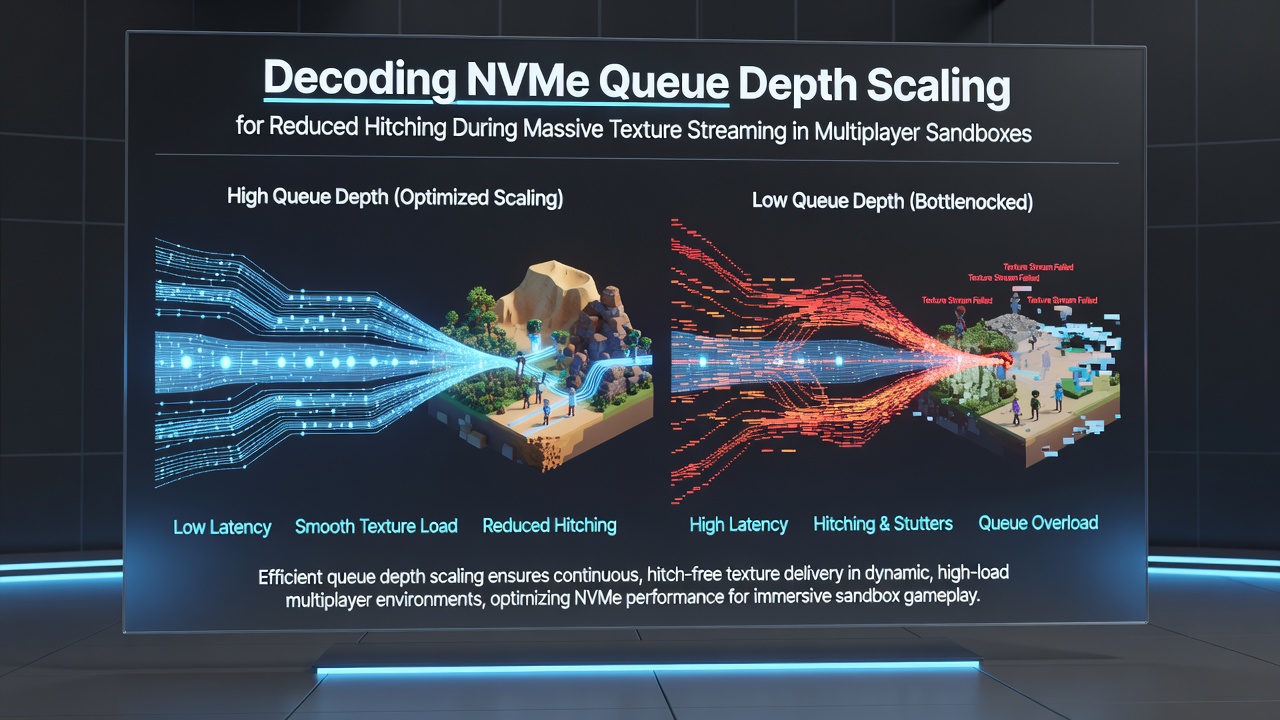
NVMe storage protocols have evolved to handle intense input-output demands in modern multiplayer sandboxes where texture streaming occurs at scales that push conventional drive architectures to their limits, and queue depth scaling emerges as a key variable that directly influences frame delivery consistency during large-scale asset loads. Developers configure NVMe controllers to adjust the number of outstanding commands per queue, which allows systems to process parallel read requests for mipmapped textures without forcing the CPU to wait on sequential completions that manifest as visible hitches.
Queue depth refers to the maximum number of commands an NVMe drive can manage simultaneously, and scaling this value upward permits greater concurrency when games stream gigabytes of texture data across networked sessions that involve dozens of players loading unique environment assets at once. Research from storage industry groups shows that default queue depths around 32 commands often prove insufficient for titles featuring dynamic world generation, whereas values scaling to 128 or higher align better with the burst patterns seen in massive multiplayer environments.
Core Mechanics of NVMe Queues in Gaming Workloads
NVMe organizes commands into submission and completion queues that operate independently of legacy SATA limitations, which means game engines can issue thousands of small texture tile reads without the overhead of command serialization that previously created micro-stutters. Observers note that when queue depth scales dynamically based on real-time I/O pressure, the controller maintains higher utilization rates on teh PCIe lanes connecting the drive to the system, and this sustained throughput prevents the texture cache from depleting mid-frame. Data from performance monitoring tools indicates that adaptive scaling algorithms monitor pending command counts and increase queue limits during peak streaming phases such as zone transitions or player convergence events.
Multiplayer sandboxes compound these demands because each client must handle both local asset streaming and synchronization packets that compete for storage bandwidth, so queue depth adjustments become essential for balancing foreground texture loads against background decompression tasks. Engineers implement feedback loops that sample queue occupancy every few milliseconds and raise the depth parameter when latency thresholds approach the point where frame pacing breaks down. According to specifications maintained by the NVM Express organization, controllers support queue depths up to 65535 per queue, yet practical implementations in consumer hardware rarely exceed a few hundred without incurring diminishing returns from interrupt overhead.
Texture Streaming Patterns and Hitching Triggers
Massive texture streaming relies on predictive loading routines that anticipate player movement through open environments, yet sudden changes in view direction or network-driven entity spawns can overwhelm fixed queue configurations and produce visible hitches lasting multiple frames. Those who've analyzed frame time graphs across sessions observe that hitch spikes correlate strongly with periods when the number of pending texture reads exceeds the active queue depth, forcing the engine to stall while commands complete serially. Scaling the depth parameter allows the drive to accept more parallel requests, which keeps the PCIe bus saturated and reduces the duration of these stalls even when total data volume remains constant.
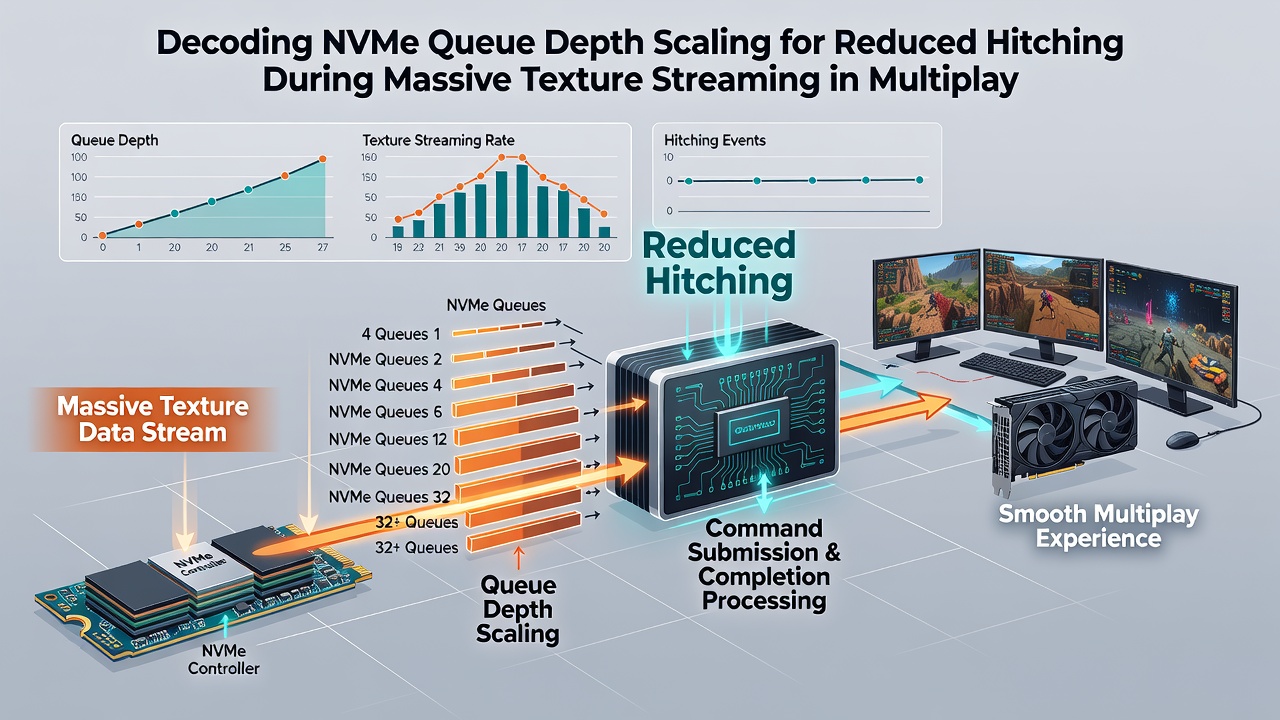
June 2026 brought renewed focus on these interactions as several engine updates introduced finer-grained control over storage command scheduling, enabling titles to respond to queue saturation signals without requiring full driver recompilation. Studies conducted at technical universities in Canada and Australia have quantified how increasing queue depth from 64 to 256 commands can reduce average texture load latency by measurable margins during simulated 64-player convergence scenarios, particularly when combined with asynchronous decompression pipelines.
Implementation Considerations Across Hardware Platforms
Platform differences affect how queue depth scaling translates into reduced hitching because console storage stacks often expose fewer tunable parameters than PC drivers, while high-end desktop NVMe devices paired with recent chipsets demonstrate clearer benefits from dynamic adjustment. Software layers such as Microsoft DirectStorage expose interfaces that let developers hint at desired queue behaviors, and evidence suggests that games leveraging these APIs achieve more consistent streaming when the underlying controller scales depth in response to workload telemetry. Industry reports from European trade associations highlight that systems equipped with multiple NVMe drives in RAID configurations can distribute queue loads across physical devices, further smoothing texture delivery during extended play sessions that involve continuous world streaming.
Power and thermal constraints also play roles because deeper queues increase drive activity and may trigger thermal throttling in compact chassis, which in turn lengthens command completion times and reintroduces the very hitches that scaling aims to eliminate. Calibration routines therefore incorporate temperature monitoring alongside queue occupancy metrics to maintain balanced operation across varied session lengths and ambient conditions.
Conclusion
Queue depth scaling on NVMe devices provides a measurable lever for minimizing hitching during intensive texture streaming in multiplayer sandboxes by enabling greater command concurrency that matches the bursty access patterns inherent to these environments. Continued refinement of driver-level controls and engine integration promises further alignment between storage capabilities and the demands of large-scale shared worlds, with ongoing measurements from research institutions confirming incremental gains as hardware and software stacks mature.