Decoding Storage Interface Interactions with Asset Streaming Protocols in Expansive Open-World Simulations
Written by Petra Carter · Jun 14, 2026
Decoding Storage Interface Interactions with Asset Streaming Protocols in Expansive Open-World Simulations
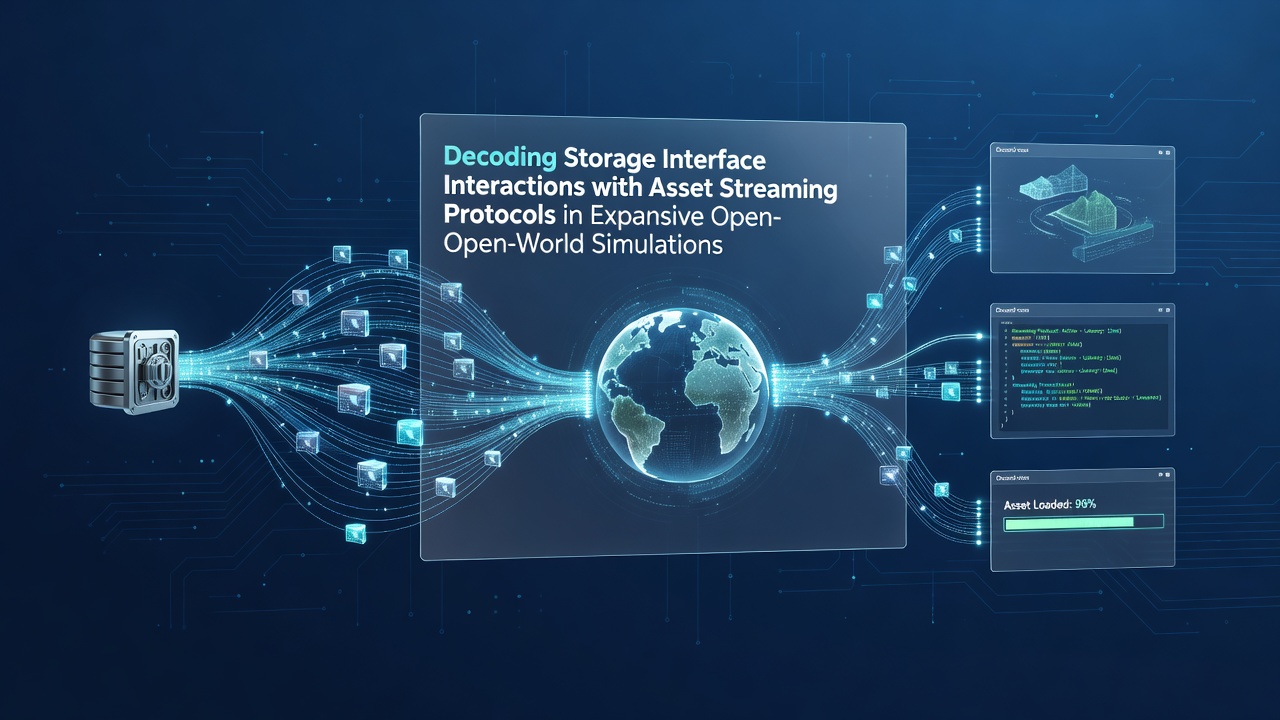
Storage interfaces like NVMe over PCIe interact with asset streaming protocols through high-bandwidth data pathways that support continuous loading of textures, meshes, and environmental data in expansive simulations. These systems rely on direct memory access mechanisms which bypass traditional CPU bottlenecks and allow game engines to pull assets from solid-state drives as players traverse large virtual spaces. Researchers at various institutions have documented how this setup reduces latency during transitions between regions in titles featuring vast maps and dynamic worlds. Engineers design asset streaming protocols to manage memory pools efficiently while coordinating with storage controllers that handle queue depths and command sets. Data flows from the drive through the interface controller into GPU-accessible buffers where decompression occurs on the fly. This coordination becomes essential in open-world environments because the volume of assets exceeds available system memory at any given moment.Core Components of Storage Interfaces in Gaming Hardware
NVMe protocols operate over PCIe lanes and deliver sequential read speeds that exceed 7000 megabytes per second in current consumer drives. These speeds enable protocols to request small chunks of data on demand rather than loading entire levels into RAM upfront. Interface specifications include support for multiple queues which allow simultaneous read operations from different parts of the storage medium. Controllers within the drive firmware manage wear leveling and error correction while maintaining consistent performance under sustained loads. Gaming systems benefit when these controllers align with software layers that prioritize asset requests based on player position and view frustum calculations. Studies from European research centers indicate that optimized queue management correlates with smoother frame delivery during exploration sequences.Asset Streaming Protocols and Their Operational Logic
Streaming protocols divide world data into spatial partitions such as chunks or cells that load progressively as coordinates update. They employ predictive algorithms that preload nearby assets based on movement vectors and camera orientation. This approach integrates with storage interfaces by issuing prioritized I/O commands that favor visible or soon-to-be-visible elements. Bandwidth allocation occurs dynamically so that critical assets like character models receive higher priority than distant background elements. Protocols also handle fallback mechanisms when storage throughput drops temporarily due to thermal throttling or concurrent system tasks. Observers note that effective integration prevents pop-in artifacts which disrupt immersion in large-scale simulations.