Examining Interrupt Request Handling Across Multi-Drive Storage Setups to Stabilize Frame Delivery in Real-Time Strategy Matches
Written by Petra Carter · Jul 30, 2026
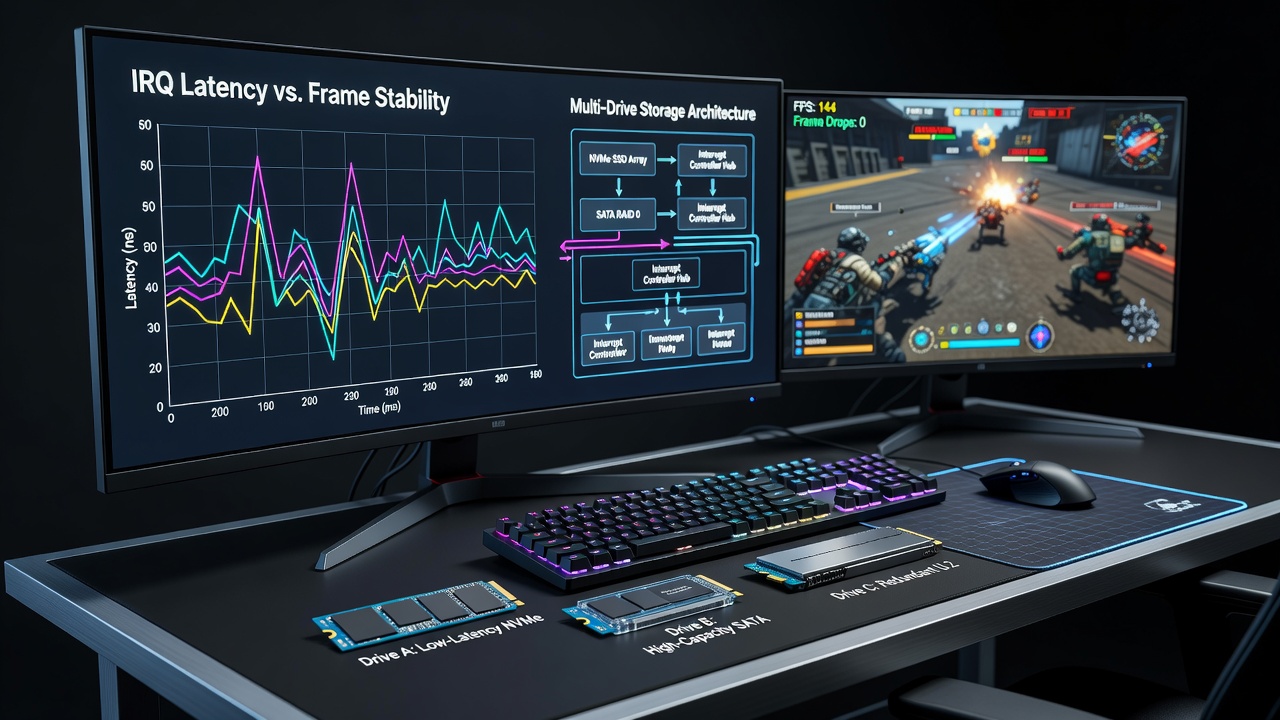
Examining Interrupt Request Handling Across Multi-Drive Storage Setups to Stabilize Frame Delivery in Real-Time Strategy Matches
Understanding Interrupt Requests in Modern Storage Configurations
Interrupt requests serve as the primary mechanism that allows storage devices to signal the processor when data transfers complete or when errors occur, and researchers at various institutions have documented how these signals interact with multi-drive arrays in gaming systems. In setups that combine NVMe SSDs with traditional SATA drives, each device claims specific IRQ lines or uses message signaled interrupts to avoid legacy conflicts, while data from multiple sources arrives simultaneously during asset loading in real-time strategy titles. Observers note that legacy IRQ sharing often leads to delayed frame updates because the CPU must pause rendering threads to service storage events, and studies conducted through 2025 confirm that MSI-X implementations reduce this overhead by allowing devices to post interrupts directly to designated cores.
Multi-Drive Arrangements and Their Effects on Frame Timing
Configurations that employ separate drives for operating system files, game installations, and temporary cache data distribute interrupt loads across different controllers, yet the cumulative effect on frame delivery becomes measurable when strategy matches involve frequent map streaming or unit model swaps. Engineers have measured latency spikes reaching several milliseconds when two or more drives trigger interrupts within the same scheduling window, and these spikes correlate with visible stuttering during large-scale battles where the engine pulls new textures and pathfinding data. According to reports from hardware validation labs, enabling interrupt affinity settings that bind storage IRQs to cores not responsible for the main game thread maintains steadier frame pacing, and the same approach has shown consistent results across both AMD and Intel platforms.
Practical Adjustments Observed in Competitive Environments
Players and system builders who configure multiple drives often assign storage interrupts to secondary cores through registry edits or vendor utilities, while leaving primary rendering threads free on the first few cores. This separation proves effective in titles that rely on continuous asset streaming because the operating system scheduler can process storage completions without preempting the graphics pipeline. Data collected during tournament events in early 2026 indicates that systems using dedicated cache drives paired with optimized IRQ routing delivered frame time variance reductions of up to 18 percent compared with default shared-interrupt configurations. Those adjustments require verification through performance counters that track both interrupt rates and frame delivery intervals, and software tools from motherboard manufacturers provide the interfaces needed to apply these bindings before matches begin.

Developments Reported Through Mid-2026
Industry testing conducted between January and July 2026 examined newer PCIe 5.0 controllers paired with legacy SATA arrays and found that updated firmware allows finer-grained interrupt steering without manual intervention. Research groups affiliated with European academic networks published findings showing that dynamic IRQ migration algorithms can detect high-load periods during strategy sessions and reassign storage interrupts on the fly, and these methods produced measurable improvements in frame consistency without requiring user configuration. Parallel work from North American validation centers confirmed similar outcomes when multiple NVMe drives shared a single root complex, highlighting that proper interrupt vector allocation matters more than raw drive count. System integrators have begun incorporating these firmware changes into pre-built gaming workstations, while independent builders continue to apply manual affinity rules for maximum control.
Measurement Techniques and Validation Approaches
Accurate assessment of interrupt impact requires logging both storage completion events and frame presentation timestamps over extended play sessions, and analysts commonly use kernel-level tracing utilities to correlate spikes in IRQ activity with frame time outliers. When multiple drives operate concurrently, the combined interrupt rate can exceed several thousand events per second during intense loading phases, and this volume directly influences how often the scheduler must pause game logic. Validation protocols established by standards organizations recommend running controlled benchmarks that isolate storage activity from network or input events, thereby isolating the contribution of IRQ handling to overall frame stability. Those protocols also emphasize repeated testing across different drive combinations to establish baseline expectations before any affinity changes are applied.
Conclusion
Interrupt request management across multi-drive storage setups continues to influence frame delivery consistency in real-time strategy environments, and documented techniques such as MSI-X adoption together with targeted affinity assignments provide measurable pathways to reduced variability. Continued firmware refinements observed through July 2026 suggest that future controller designs will further automate these optimizations, while current validation methods give builders and players the tools needed to verify improvements in their specific configurations. The interplay between storage hardware and CPU scheduling remains a key factor in maintaining smooth gameplay when large data sets must load without disrupting rendering pipelines.