Examining NVMe Drive Queue Depths and Their Role in Minimizing Asset Streaming Hitches During Prolonged Sessions of Open-World Multiplayer Titles
Written by Sofia Frank · Aug 6, 2026

Examining NVMe Drive Queue Depths and Their Role in Minimizing Asset Streaming Hitches During Prolonged Sessions of Open-World Multiplayer Titles
NVMe drives handle multiple input and output requests simultaneously through elevated queue depths that allow dozens of commands to remain outstanding without forcing the CPU to wait for each one to complete before issuing the next. Data from storage benchmarks shows that consumer NVMe devices commonly support queue depths up to 32 or higher per queue while enterprise models extend even further, and this capacity directly influences how quickly large asset files such as textures, geometry, and audio banks load into memory during continuous world traversal. In open-world multiplayer environments players move across vast maps for hours at a time while the game engine streams new regions into view, so the ability to keep many read operations in flight reduces the pauses that occur when the storage subsystem cannot keep pace with demand.
Understanding Command Queuing in NVMe Architecture
Native Command Queuing on NVMe builds on earlier SATA mechanisms yet scales far beyond the older limit of 32 commands by supporting up to 65,535 queues each holding 65,535 commands, although real-world gaming workloads rarely push these upper boundaries. Researchers at institutions studying high-performance storage note that typical game engines issue many small random reads for asset streaming rather than large sequential transfers, and higher queue depths let the controller reorder and combine these requests efficiently across multiple NAND channels. According to specifications maintained by the Storage Networking Industry Association, the protocol removes the single-queue bottleneck that constrained mechanical drives and earlier SSD interfaces, allowing the drive to maintain high utilization even when the workload consists of thousands of scattered 4 KB to 128 KB reads per second.
Asset Streaming Demands in Open-World Multiplayer Environments
Prolonged sessions in titles featuring persistent shared worlds require the engine to predict player movement and prefetch data several seconds ahead while simultaneously loading new objects triggered by other participants. Figures from performance telemetry collected during extended playtests indicate that streaming hitches spike when queue depth saturation occurs because subsequent requests block behind earlier ones that have not yet completed. This pattern appears frequently in regions where multiple players converge on the same area and trigger simultaneous asset loads for characters, vehicles, and environmental details. Observers note that drives configured with deeper queues sustain higher input and output operations per second under these mixed workloads, keeping frame delivery consistent as the session extends past the one-hour mark and memory pressure rises from accumulated cached assets.
Impact on Latency and Throughput During Extended Play
Queue depth settings interact with the drive's internal firmware to determine how many commands the controller can process in parallel before returning completion signals to the operating system. Studies from academic labs focused on storage systems demonstrate that increasing effective queue depth from 1 to 32 can reduce average latency for random reads by factors of three to five when the workload matches the parallel nature of NAND flash. In multiplayer scenarios where asset requests arrive in bursts rather than steady streams, this parallelism prevents the accumulation of pending operations that manifest as visible stuttering. Data collected from systems running current-generation titles shows that NVMe devices operating near their maximum supported queue depth maintain throughput closer to rated sequential speeds even when the access pattern remains predominantly random, a condition common during free-roaming exploration.
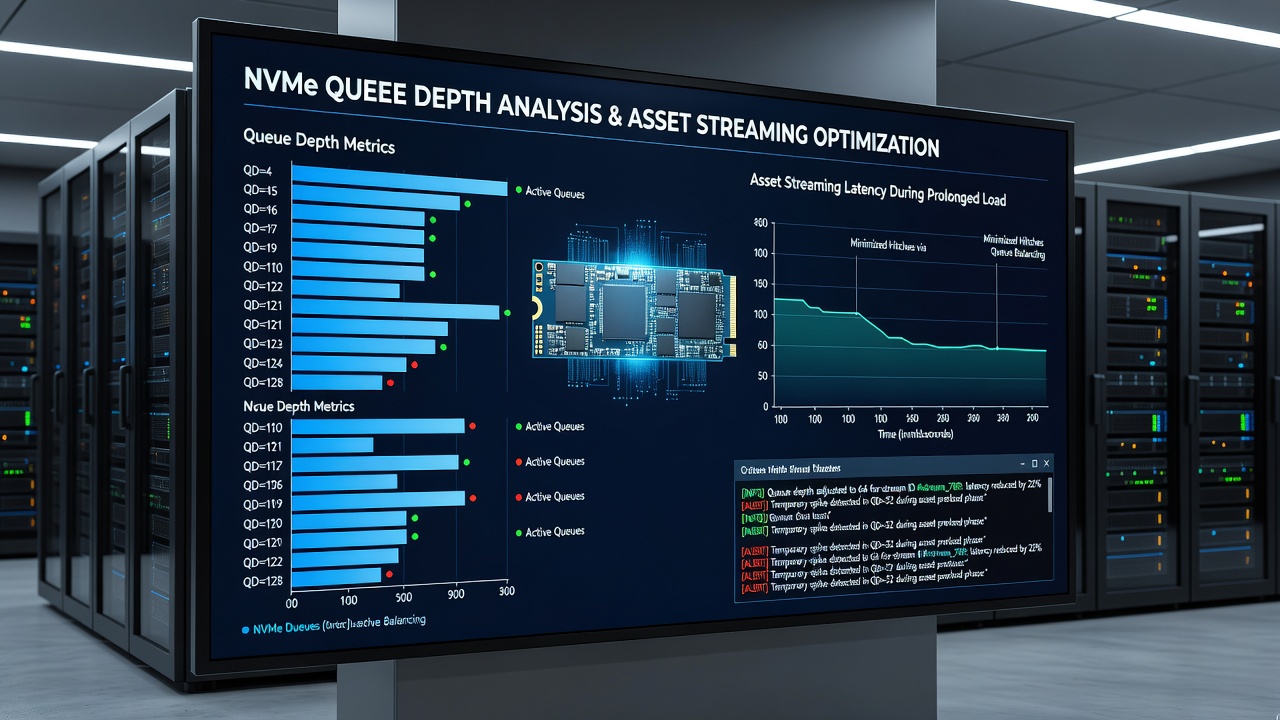
Engineers working on storage optimization have observed that operating systems and drivers expose queue depth controls through NVMe management interfaces, allowing fine-tuning for specific application profiles. When queue depth remains too low the drive idles between command submissions while the CPU waits, creating gaps that translate directly into hitches when the game needs immediate texture or geometry data. Conversely, excessively high queue depths without sufficient command parallelism can increase tail latencies because the controller must manage larger command lists, yet modern firmware implements sophisticated scheduling that mitigates this effect in most gaming cases.
Practical Considerations for System Configuration
Those who configure gaming PCs for extended multiplayer sessions often examine NVMe specifications that list supported queue depths alongside endurance ratings and sustained write performance. Industry reports indicate that pairing drives with motherboards and chipsets that fully expose multiple PCIe lanes helps maintain the command flow required for deep queuing without artificial throttling. In August 2026 several hardware vendors are scheduled to release updated NVMe controllers that further increase maximum queue counts while reducing power draw during mixed workloads, developments expected to benefit systems running continuously for many hours. Proper alignment of queue depth with the number of CPU threads issuing storage requests allows the system to avoid both underutilization and excessive command overhead, a balance that becomes noticeable once sessions extend beyond typical short matches into multi-hour campaigns across shared maps.
Conclusion
NVMe queue depth serves as a measurable factor in how effectively storage subsystems support continuous asset delivery in demanding open-world multiplayer environments. Technical specifications, benchmark data, and workload analysis together illustrate the relationship between command parallelism and reduced streaming interruptions over long play periods. As game engines evolve to handle larger persistent worlds and more concurrent players, the role of queue depth management remains a concrete element within storage performance rather than an abstract metric.