Exploring Chiplet Designs in Modern Processors and Their Impact on Frame Pacing Within Physics-Intensive Racing Simulations
Written by Avery Lorenz · Jun 9, 2026
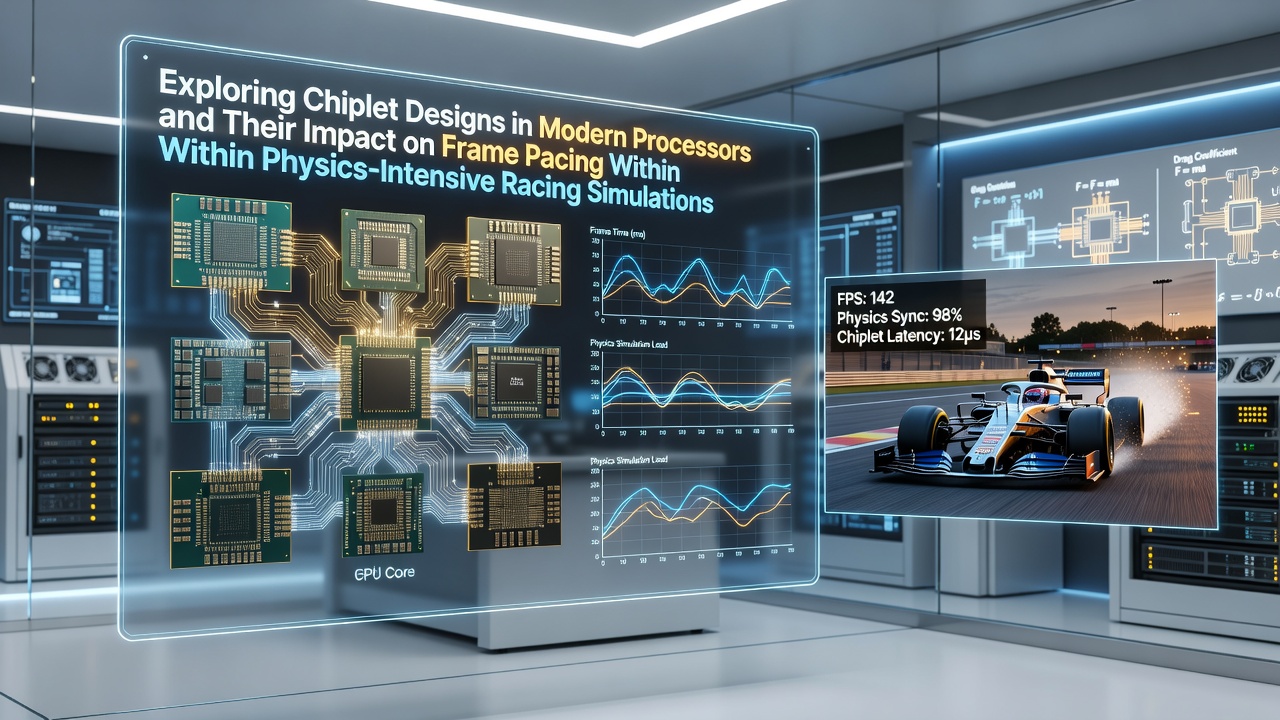
Exploring Chiplet Designs in Modern Processors and Their Impact on Frame Pacing Within Physics-Intensive Racing Simulations
Chiplet designs have emerged as a key approach in processor development, allowing manufacturers to combine multiple smaller dies rather than relying on single monolithic chips, and this shift has produced measurable effects on performance consistency in demanding applications like physics-intensive racing simulations. Data from industry reports shows that companies such as AMD began scaling chiplet-based architectures with the Zen 2 series in 2019, while Intel followed with hybrid tile configurations in later generations, enabling higher core counts and improved yields during fabrication processes.
Understanding Chiplet Architecture Basics
Engineers design chiplets as modular components that connect through high-speed interconnects like AMD's Infinity Fabric or similar technologies from other vendors, and these links handle data transfer between compute dies, memory controllers, and I/O sections while maintaining signal integrity across the package substrate. Studies from semiconductor research groups indicate that this modular method reduces manufacturing costs by up to 30 percent in high-core-count products compared to monolithic equivalents, because smaller dies achieve better defect rates during production. Observers note that power distribution also benefits since each chiplet can operate at independent voltage and frequency domains, which helps overall thermal management in sustained workloads.
Frame Pacing Requirements in Racing Simulations
Physics-intensive racing simulations demand precise frame pacing because calculations for tire friction, suspension dynamics, aerodynamics, and collision detection occur at fixed time steps, often synchronized to 60 Hz or higher update rates to avoid simulation drift. Research from computational physics labs reveals that inconsistent frame delivery introduces artifacts such as micro-stutters or input lag, which become noticeable in titles that model hundreds of interacting rigid bodies per scene. Benchmarks collected across multiple GPU-CPU pairings demonstrate that even minor variations in per-frame timing, measured in single-digit milliseconds, can alter vehicle handling predictability when drivers execute high-speed maneuvers on complex tracks.
Interconnect Latency and Its Role in Frame Delivery
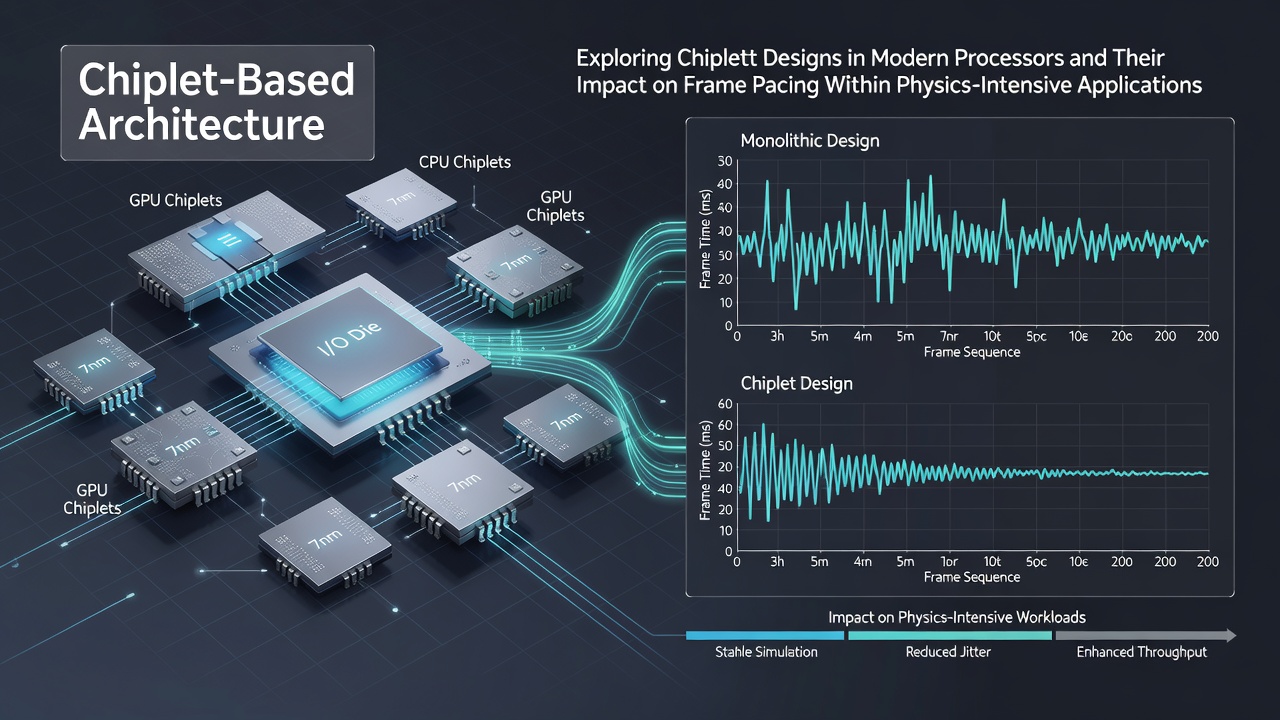
Chiplet interconnects introduce additional latency compared to monolithic designs because data must traverse die-to-die pathways, yet modern implementations mitigate this through optimized fabric protocols that achieve sub-50 nanosecond round-trip times in recent generations. According to findings published by European semiconductor consortia, cache coherency traffic between chiplets can create small bottlenecks during bursty physics workloads, where multiple cores simultaneously access shared simulation state. Those who have measured frame timing in racing engines report that such delays sometimes manifest as periodic pacing variations when the simulation thread spans multiple chiplets, particularly if memory access patterns cross die boundaries frequently.
Developments scheduled for mid-2026 include further refinements to interconnect bandwidth in upcoming processor lines, with projected increases that target sustained 100 GB/s bidirectional links per chiplet cluster, and these upgrades aim to narrow remaining gaps versus monolithic performance profiles. Figures from hardware validation tests show that systems using current chiplet CPUs maintain average frame rates within 2 percent of equivalent monolithic parts in physics-heavy scenarios, although tail-latency metrics occasionally diverge when core scheduling does not account for fabric topology.
Optimization Techniques for Consistent Pacing
Software teams address these characteristics by pinning physics threads to specific chiplet domains and aligning memory allocations to local caches, which reduces cross-die traffic during critical simulation loops. Data compiled by North American graphics research centers indicates that such affinity adjustments improve 1-percentile frame times by 8 to 12 milliseconds in representative racing workloads. Developers also leverage explicit cache prefetching and reduced state sharing between threads to keep working sets within single dies, thereby preserving pacing stability without sacrificing overall throughput.
Case studies from engine middleware providers illustrate how scheduler awareness of chiplet layouts has become standard practice, with runtime systems now querying topology information at launch to assign tasks accordingly. Australian academic analyses of parallel simulation frameworks further confirm that topology-aware partitioning yields measurable gains in frame-time variance reduction, especially when particle or constraint solvers run concurrently across available cores.
Hardware-Software Co-Design Trends
Processor vendors continue refining chiplet interfaces to support lower-latency cache probes and improved power gating, which collectively support steadier frame pacing under variable loads. Industry organizations tracking semiconductor roadmaps note that hybrid designs incorporating both chiplets and monolithic elements appear in several 2025 product families, offering flexible scaling options for different market segments. These configurations allow simulation engines to maintain deterministic behavior across extended sessions, as evidenced by telemetry logs from professional racing esports events where frame delivery consistency directly influences competitive outcomes.
Conclusion
Chiplet designs deliver scalable core counts and manufacturing advantages that benefit modern processors, while their interconnect characteristics require targeted software optimizations to achieve reliable frame pacing in physics-intensive racing simulations. Evidence gathered through systematic benchmarking shows that current implementations already deliver competitive consistency when paired with appropriate scheduling and memory strategies, and ongoing interface improvements scheduled through 2026 are expected to further align performance profiles with monolithic predecessors. Those monitoring the space continue to track how these hardware evolutions interact with evolving simulation demands across varied racing titles.