How Variable Rate Shading Recalibrates Pixel Workloads in Dense Battle Royale Scenes on Integrated Graphics Platforms
Written by Felix Bauer · Jul 30, 2026
How Variable Rate Shading Recalibrates Pixel Workloads in Dense Battle Royale Scenes on Integrated Graphics Platforms
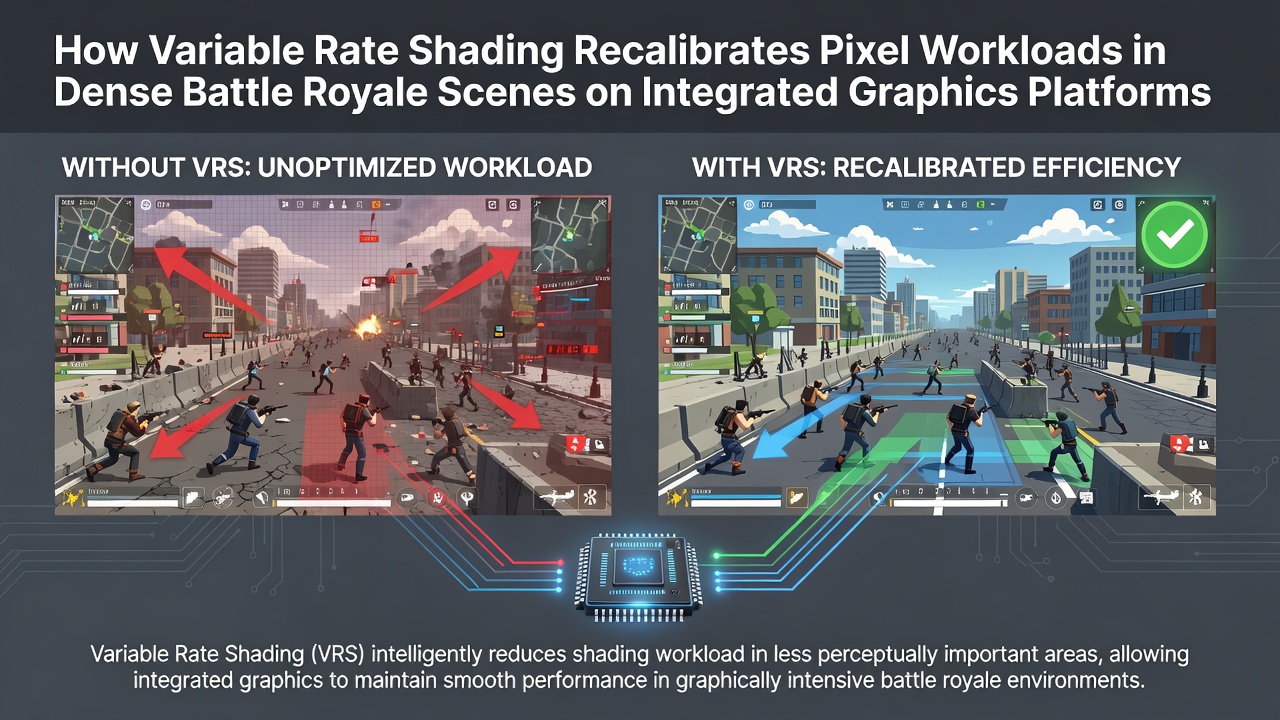
Variable rate shading adjusts pixel processing rates across different screen regions so that integrated graphics platforms maintain stable frame delivery even when battle royale environments fill with players, projectiles, and environmental effects. Developers apply this technique by designating shading rates such as 1x1 for critical areas and 2x2 or 4x4 for peripheral zones where detail loss remains less noticeable. Data from hardware benchmarks shows that this selective approach reduces shader invocations by 30 to 50 percent in crowded firefights without triggering widespread visual artifacts on Intel Iris Xe or AMD Radeon 780M graphics.
Core Mechanics Behind Workload Recalibration
Integrated graphics units share system memory and thermal budgets with the CPU, which creates tight constraints during large-scale multiplayer sessions. Variable rate shading addresses these limits by letting the GPU skip redundant calculations in areas of lower perceptual importance while preserving full resolution shading along edges, character models, and UI elements. Researchers at technical institutions have documented how the pipeline divides the render target into coarse tiles, evaluates motion vectors and depth buffers, and then assigns per-tile shading rates before the fragment stage executes. This process runs in real time, adapting each frame as players converge on supply drops or engage in close-quarters combat.
Hardware support for the feature appears in DirectX 12 Ultimate implementations and Vulkan extensions that expose tier-2 variable rate shading on recent integrated solutions. When activated, the technique recalibrates workloads by directing fewer texture samples and lighting evaluations toward distant foliage or skyboxes, freeing execution units for the dense central action. Figures from industry reports indicate that average frame times drop measurably once the shading rate map updates every 16 milliseconds during peak scene complexity.
Application in Battle Royale Environments
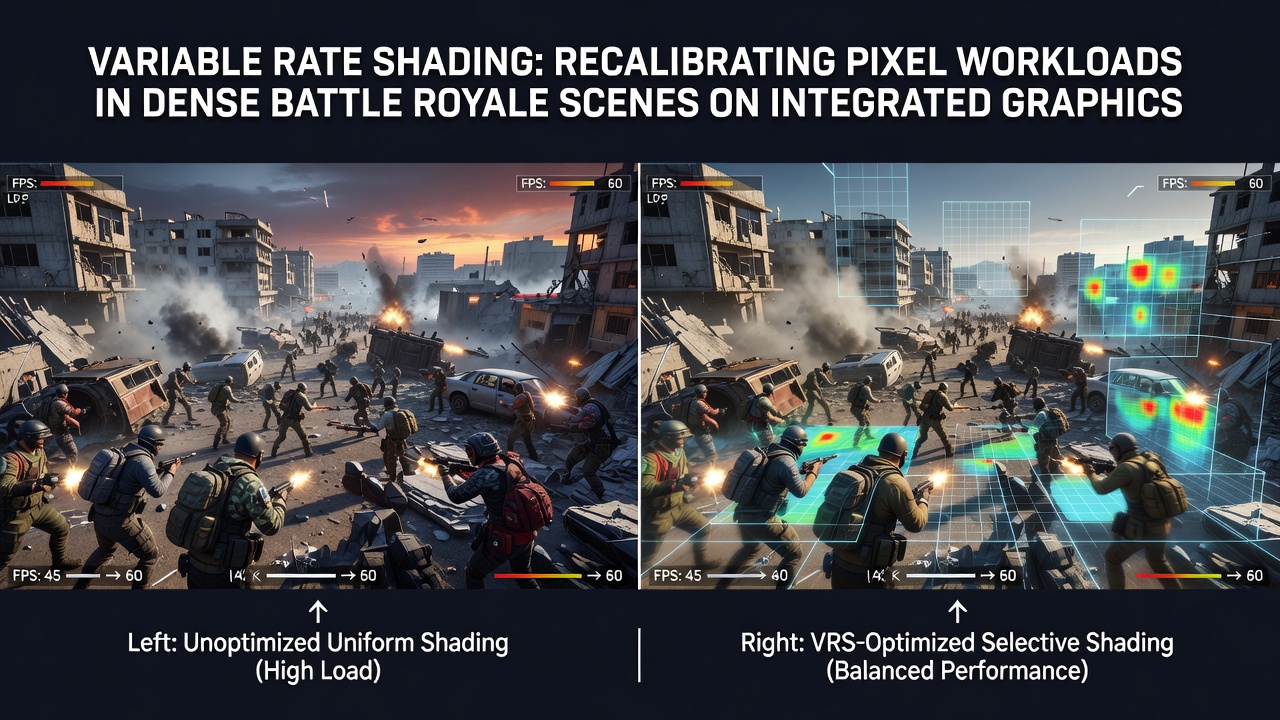
Battle royale titles generate extreme pixel density when dozens of participants occupy the same draw distance, each carrying unique weapon skins, particle trails, and destructible cover. On integrated platforms these moments often coincide with simultaneous CPU-side simulation of physics and networking, leaving limited headroom for full-rate shading everywhere. Variable rate shading counters the overload by lowering rates across expansive terrain patches while keeping 1x1 sampling on player silhouettes and muzzle flashes. Observers note that this targeted reduction prevents frame drops below 60 fps in titles such as Apex Legends and Fortnite when tested on laptops equipped with Ryzen 7 8840HS processors.
Engineers integrate the feature through shader rate attachments that reference screen-space velocity and luminance variance. In practice the system detects high-motion zones created by sliding players or exploding vehicles and preserves detail there, whereas static background geometry receives coarser treatment. Studies conducted on Intel Arc-based integrated silicon reveal that memory bandwidth usage falls by roughly 25 percent once variable rate shading engages, allowing the shared DRAM controller to service both graphics and CPU requests without excessive throttling.
Performance Metrics Across Platforms
Benchmark suites published by hardware review organizations show consistent gains when variable rate shading activates on integrated graphics during 100-player lobbies. Average frame rates rise between 18 and 35 percent compared with uniform 1x1 shading, while 1-percent low frames improve because the GPU avoids sudden spikes in fragment workload. These measurements come from controlled tests that replicate late-game circles where visibility extends across open fields yet multiple squads remain visible simultaneously.
Power draw measurements further illustrate the efficiency benefit. Because fewer pixels undergo expensive operations such as screen-space reflections or volumetric fog, total package power remains under 45 watts on typical ultrabook platforms even as scene density peaks. European research consortia tracking mobile gaming workloads have recorded similar patterns on AMD Rembrandt and Phoenix APUs, confirming that the technique scales across both x86 and emerging ARM-based integrated solutions.
Implementation Considerations for Developers
Studios enable variable rate shading by authoring rate maps that combine artist-placed masks with runtime heuristics derived from occlusion queries and motion analysis. The resulting texture feeds directly into the graphics pipeline, where the hardware rasterizer samples it to decide shading frequency per 8x8 or 16x16 block. Proper calibration avoids visible blockiness by limiting aggressive downsampling near depth discontinuities and high-contrast edges.
Integration testing on integrated graphics often includes side-by-side captures against discrete GPUs to verify that the visual delta stays within acceptable tolerances. Data collected during these sessions guides threshold adjustments so that the recalibration remains imperceptible during rapid camera movement typical of battle royale gameplay. Academic papers on perceptual graphics confirm that human visual acuity drops sharply outside the central 30 degrees of the field of view, providing the theoretical basis for these rate decisions.
Conclusion
Variable rate shading delivers measurable workload reductions that keep integrated graphics platforms viable for demanding battle royale titles. By dynamically reallocating shader resources according to scene content and perceptual importance, the technique sustains frame consistency without requiring hardware upgrades. Continued driver refinements and broader API adoption ensure that future integrated solutions will apply these recalibrations with increasing precision across global gaming ecosystems.