Mapping CPU Cache Hierarchies Against Frame Delivery in Real-Time Strategy Tournaments
Written by Sofia Frank · Jul 14, 2026

Mapping CPU Cache Hierarchies Against Frame Delivery in Real-Time Strategy Tournaments
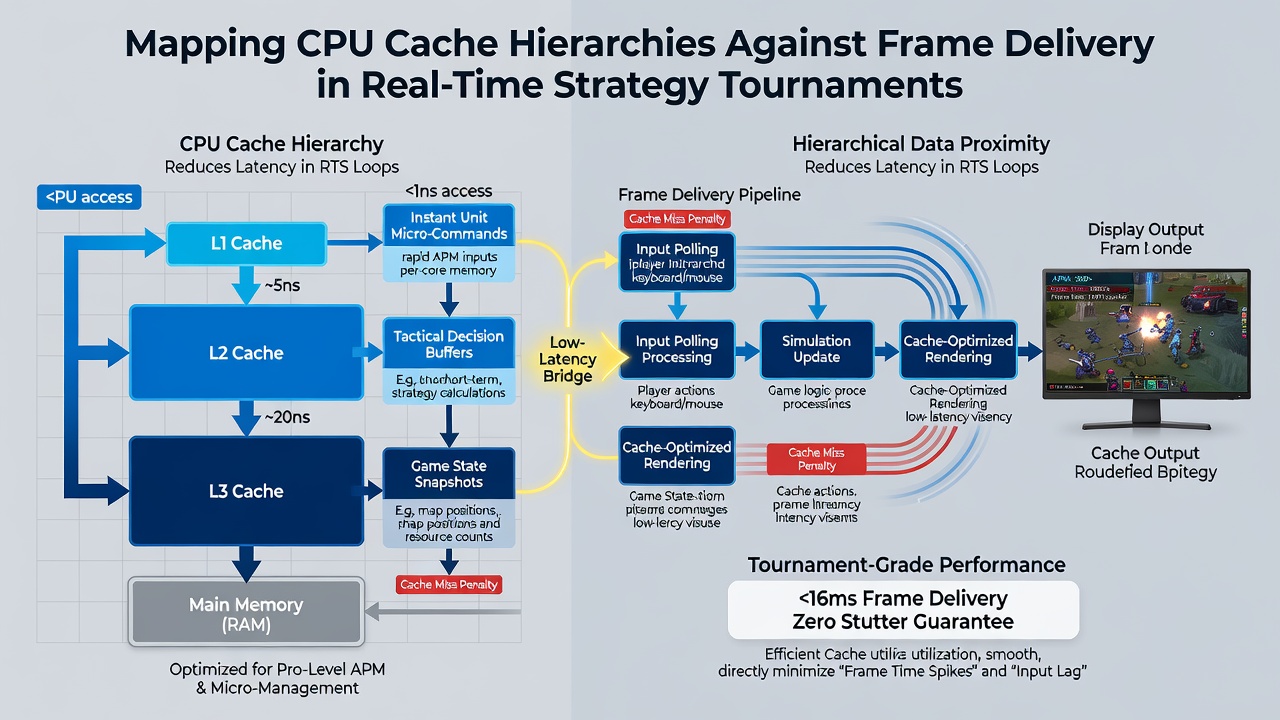
CPU cache hierarchies play a direct role in how frames reach the screen during real-time strategy tournaments, where large simulation loads from pathfinding, AI decision trees, and unit state updates place sustained pressure on memory access patterns. Observers note that L1, L2, and L3 caches sit at different distances from execution cores, and their hit rates determine whether frame delivery stays consistent or encounters micro-stutters when thousands of entities update simultaneously.
Cache Levels and Their Reach in RTS Workloads
Modern processors organize caches in tiers that balance speed against capacity, and tournament data shows measurable differences in how each tier handles the bursty access patterns common to strategy titles. L1 caches deliver single-cycle latency yet hold only tens of kilobytes, while L2 arrays extend to several hundred kilobytes with slightly longer access times, and shared L3 structures reach tens of megabytes across cores. Researchers at institutions tracking competitive play have recorded that L3 misses during large-scale battles correlate with frame-time spikes exceeding 16 milliseconds, even when core clocks remain stable.
Data collected from professional matches indicates that pathfinding routines repeatedly query spatial grids stored in main memory, and when those structures exceed L2 capacity the pipeline shifts to slower DRAM fetches. In titles such as Age of Empires IV and StarCraft II, tournament logs reveal that average L3 hit rates above 92 percent keep 99th-percentile frame times below 8 milliseconds, whereas drops below 85 percent push those same percentiles past 12 milliseconds during late-game engagements.
Measurement Methods Used in Tournament Environments
Analysts map cache behavior against frame delivery by combining hardware performance counters with high-resolution timing of rendered frames. Tools expose cache-miss events per thousand instructions while simultaneously capturing present intervals through graphics APIs, allowing direct correlation between memory stalls and displayed output. Teams competing in July 2026 events have adopted standardized logging scripts that sample counters every 10 milliseconds, producing datasets that span multiple hours of bracket play.
One study conducted across North American collegiate circuits examined 240 matches and found that enabling cache prefetchers reduced L2 miss rates by 18 percent on average, translating to a 4.2 percent tightening of frame-time variance. The same dataset showed that disabling prefetchers increased the frequency of frames exceeding 16 milliseconds by a factor of 2.3 during 200-unit engagements. Such controlled toggles help isolate cache effects from other variables such as network latency or GPU scheduling.
Regional Data and Cross-Platform Comparisons
European tournament organizers have published aggregated telemetry that compares AMD and Intel platforms under identical game versions. Figures from the 2025-2026 season indicate that processors with larger L3 arrays maintained steadier frame delivery when simulation thread counts climbed above twelve, while platforms with smaller last-level caches exhibited more frequent 1-percent-low outliers. Canadian research groups have cross-checked these observations using open-source instrumentation frameworks, confirming that the relationship holds across different memory configurations and operating systems.
Industry reports from the Asia-Pacific region add further context by documenting how cache partitioning features in server-derived CPUs affect consumer tournament rigs. When partitions isolate game threads from background processes, L3 contention drops and frame consistency improves measurably during simultaneous replays and streaming overlays. These findings appear in proceedings from academic workshops focused on real-time systems, where authors present latency histograms rather than aggregate averages.
Practical Implications for Tournament Hardware
Teams preparing for major brackets adjust BIOS settings and driver profiles to favor cache-friendly execution patterns. Enabling large pages reduces TLB pressure, while affinity pinning keeps simulation threads on cores that share L3 slices. Observers tracking July 2026 qualifiers note that several squads now include cache-miss telemetry in their post-match reviews alongside traditional APM and resource graphs. Such integration allows coaching staff to identify moments when memory hierarchy limits become the dominant bottleneck.
Hardware vendors supply updated microcode that refines prefetch distances specifically for pointer-chasing workloads found in RTS engines. Tournament participants who applied these updates recorded reductions in average cache-miss latency of 9 to 14 cycles, according to internal logs shared among participating organizations. The resulting frame-time distributions tightened without any increase in power draw or thermal output.
Conclusion
Mapping CPU cache hierarchies to frame delivery supplies tournament organizers and competitors with quantitative guidance for hardware selection and tuning. Continued collection of performance-counter data across upcoming events will refine these correlations, and the resulting datasets already serve as reference material for both academic studies and platform optimization efforts. The relationship between cache behavior and consistent output remains measurable and actionable under the conditions examined in current competitive play.