Mapping Display Panel Overdrive Settings Against Motion Artifacts in Fighting Game Circuits Across Multiple Monitor Refresh Ecosystems
Written by Petra Carter · May 26, 2026
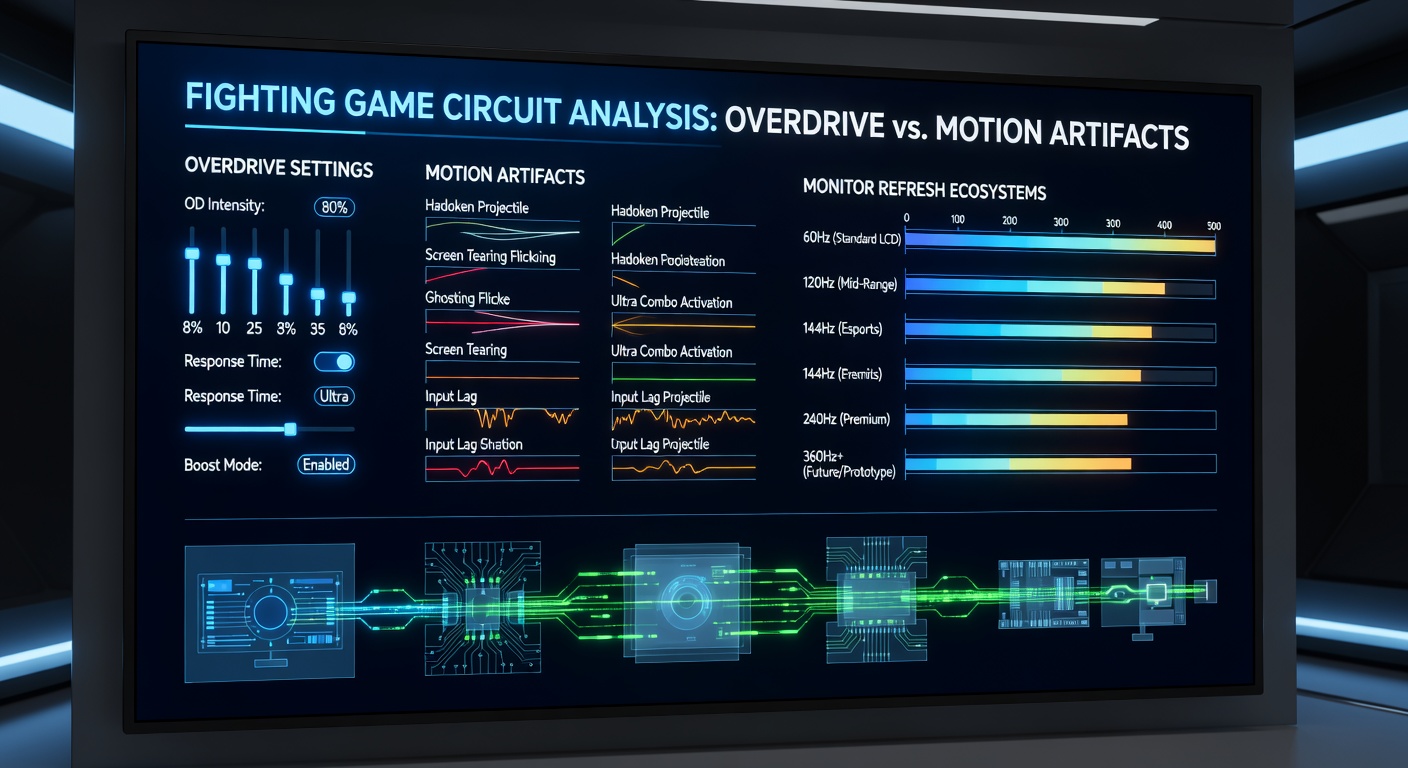
Mapping Display Panel Overdrive Settings Against Motion Artifacts in Fighting Game Circuits Across Multiple Monitor Refresh Ecosystems
Display panel overdrive adjusts voltage response times on LCD and OLED matrices to reduce pixel transition delays, yet this calibration directly influences motion artifacts such as inverse ghosting, overshoot, and trailing in fast-paced sequences. Fighting game circuits, which process frame-perfect inputs across character animations and hitbox interactions, expose these trade-offs because each visual frame must register cleanly during rapid directional changes and combo chains. Observers note that refresh rate ecosystems ranging from 60 Hz legacy panels to 540 Hz experimental units create distinct environments where overdrive levels interact with pixel response curves.
Core Mechanics of Overdrive Calibration
Overdrive functions by boosting or reducing drive voltages during pixel state changes, and manufacturers embed multiple presets labeled as normal, fast, or extreme within firmware tables. Data indicates that moderate overdrive shortens gray-to-gray transitions from 5 ms to under 1 ms on many IPS panels, while aggressive settings introduce ringing artifacts when pixels overshoot target luminance values. Researchers at display testing facilities have documented how these voltage spikes generate inverse ghosting that appears as bright or dark halos trailing moving sprites, a phenomenon that becomes pronounced in fighting titles where limb movements cross the screen in under 16 ms.
Refresh rate ecosystems further modulate outcomes because higher frequencies compress frame intervals and leave less temporal room for recovery from overshoot. At 144 Hz, panels refresh every 6.94 ms, so an overdriven pixel that settles in 3 ms fits within the window yet risks visible artifacts if the next frame arrives before stabilization completes. Panels operating at 240 Hz tighten this margin to 4.17 ms, forcing tighter correlation between overdrive strength and native response characteristics. Studies from European display laboratories reveal that OLED ecosystems, with their near-instantaneous pixel decay, require different overdrive mapping compared to LCD backplanes that retain charge longer.
Motion Artifacts Specific to Fighting Game Circuits
Fighting game engines render at fixed tick rates that often align with monitor refresh boundaries, and motion artifacts disrupt the visual parsing of attack startups, active frames, and recovery animations. Trailing edges on projectile sprites or character limbs create ambiguity in timing windows measured in single frames, while overshoot produces phantom edges that players interpret as additional hitbox extensions. Tournament data collected through 2025 and into May 2026 shows increased reports of visual interference on high-refresh setups when overdrive presets exceed manufacturer-recommended thresholds for the panel's native refresh ecosystem.
Multiple monitor technologies compound the mapping challenge. TN panels exhibit faster native transitions yet suffer color shift at off-axis angles common in arcade cabinet viewing, whereas VA panels deliver deeper blacks but demonstrate slower dark-to-dark shifts that overdrive must compensate. HDMI Forum specifications and VESA adaptive-sync protocols influence how variable refresh interacts with fixed overdrive tables, and firmware updates released in early 2026 have begun exposing more granular overdrive sliders for select high-refresh models.
Cross-Ecosystem Mapping Approaches
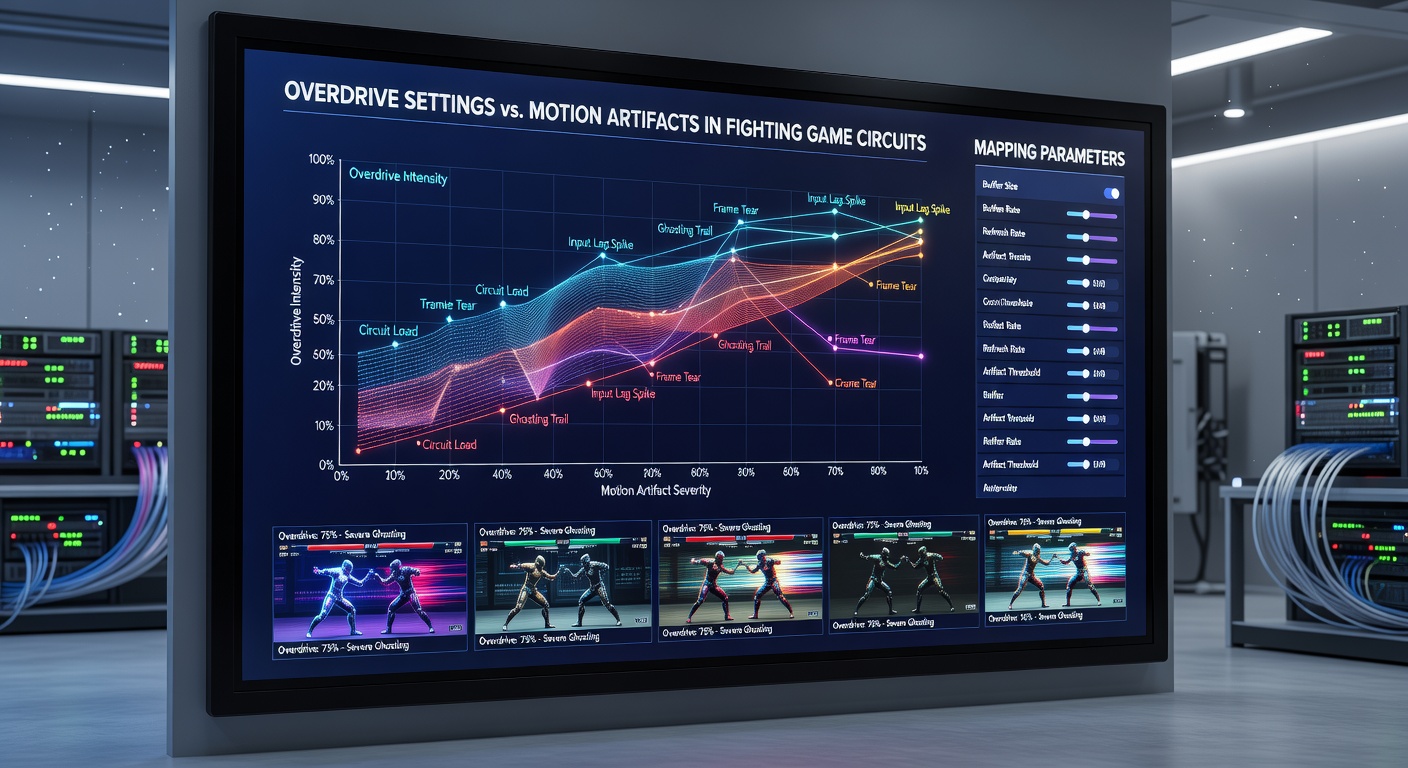
Engineers construct mapping tables by measuring pixel response with high-speed cameras and oscilloscopes while cycling through overdrive presets at each supported refresh rate. These tables plot artifact severity scores against input lag measurements and frame delivery consistency, revealing that 60 Hz ecosystems tolerate stronger overdrive before artifacts exceed visibility thresholds because longer frame times mask minor overshoot. In contrast, 360 Hz and 540 Hz ecosystems demand conservative settings to prevent ringing that becomes perceptible within the shorter temporal envelope.
Industry reports compiled by the Society for Information Display document systematic testing across panel batches, showing variance even within identical model lines due to manufacturing tolerances in liquid crystal mixtures and driver IC calibration. Fighting game communities have compiled community-driven databases that correlate specific monitor models with recommended overdrive values for titles running at different engine tick rates, and these datasets continue to expand as new panels enter the market through 2026.
Practical Implementation Across Refresh Ecosystems
Users access overdrive controls through on-screen display menus or manufacturer software utilities that expose preset levels calibrated for common refresh rates. When switching between 60 Hz desktop modes and 240 Hz gaming modes, the same physical panel applies different voltage boost tables, and failure to adjust overdrive accordingly produces either persistent blur or exaggerated artifacts. Adaptive sync technologies such as AMD FreeSync and NVIDIA G-Sync further layer frame delivery variability onto these fixed tables, requiring dynamic overdrive compensation that some panels implement through firmware algorithms.
Research conducted at institutions including the University of Waterloo demonstrates measurable differences in artifact profiles when overdrive mapping accounts for both refresh rate and content motion speed typical of fighting game animations. IEEE studies on high-refresh display systems provide quantitative data on transition times across ecosystems, while parallel work from Australian display research groups examines thermal drift effects on long-term calibration stability.
Conclusion
Mapping display panel overdrive against motion artifacts requires systematic measurement across refresh rate ecosystems because each combination produces unique response and artifact profiles. Fighting game circuits, with their emphasis on frame-accurate visual feedback, highlight the practical consequences of these calibrations through observable trailing, overshoot, and input interpretation challenges. Continued firmware refinements and expanded testing protocols through 2026 support more precise matching of overdrive settings to specific monitor and refresh configurations.