NVMe Protocol Updates Drive Shifts in Asset Delivery and Visual Consistency Within Expansive Game Environments
Written by Felix Bauer · Aug 16, 2026
NVMe Protocol Updates Drive Shifts in Asset Delivery and Visual Consistency Within Expansive Game Environments
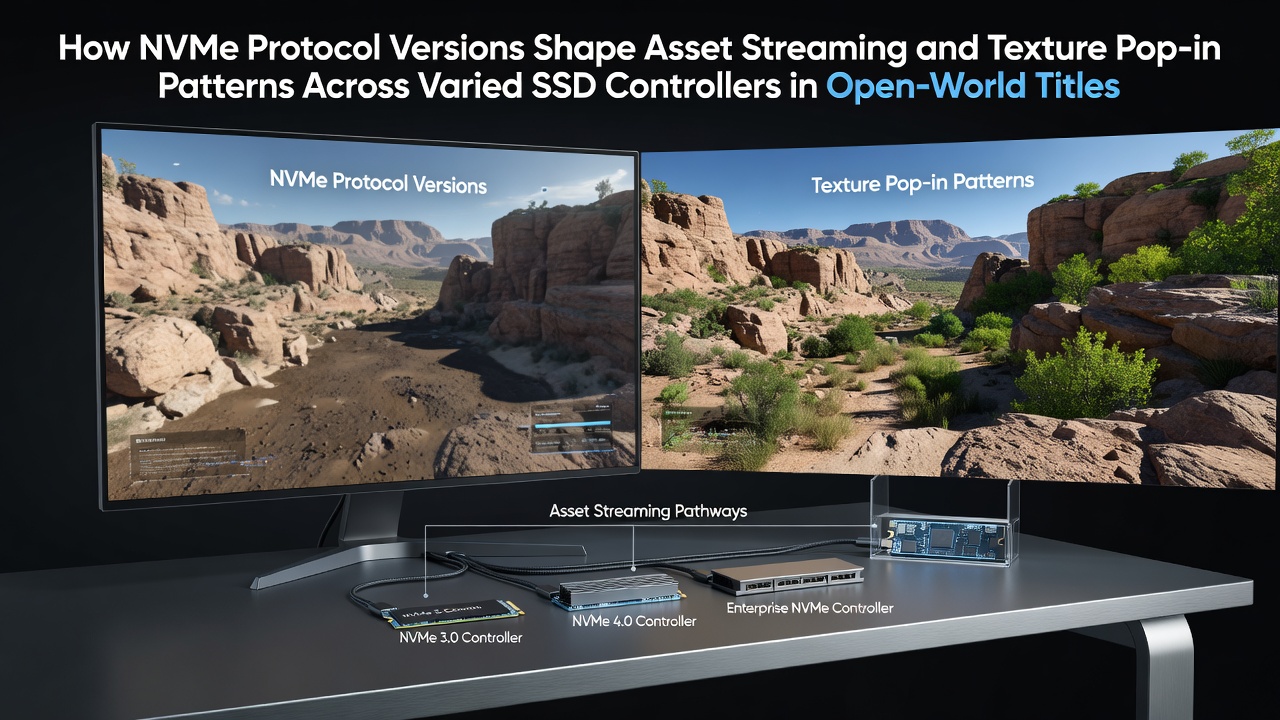
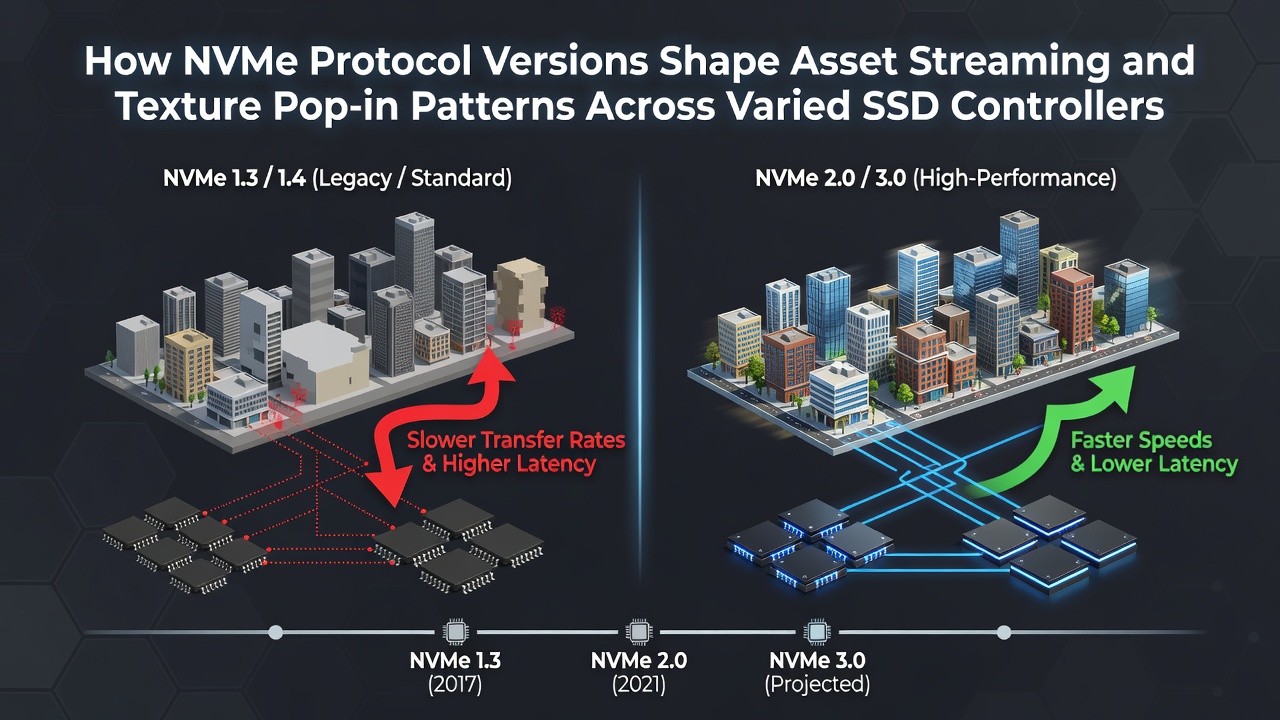
NVMe protocol versions continue to refine how open-world titles handle massive asset libraries, with each iteration altering data queues, command sets, and power states that directly influence streaming speeds across different SSD controllers. Observers note that these changes manifest in reduced texture pop-in during rapid traversal sequences, where earlier protocols like NVMe 1.3 often encountered bottlenecks compared to later revisions that support deeper command parallelism and improved error handling.
Core Differences Across NVMe Revisions
NVMe 1.4 introduced enhanced features such as persistent memory regions and better support for zoned namespaces, which allow controllers from manufacturers like Phison and Samsung to prioritize sequential reads essential for world streaming, whereas NVMe 2.0 expanded on these with improved telemetry and multi-path I/O that distribute loads more evenly across NAND dies. Researchers discovered that these updates translate into measurable reductions in latency spikes when games pull high-resolution textures from storage during dynamic scene changes. Data from controller benchmarks indicate that Phison E18-based drives exhibit tighter variance in transfer rates under NVMe 2.0 compared to their 1.3 counterparts, particularly when paired with high-core CPUs that issue simultaneous read requests.
Streaming Mechanics in Open-World Scenarios
Asset streaming relies on predictive loading algorithms that anticipate player movement and preload geometry plus textures into VRAM, yet the underlying storage protocol determines how efficiently those requests complete without stalling the render pipeline. Studies found that NVMe versions with refined interrupt coalescing reduce CPU overhead during bursty access patterns common in titles featuring vast explorable areas, allowing smoother handoff from storage to system memory. Those who've examined frame-time logs across multiple titles observe that controllers supporting the latest protocol maintain steadier throughput when the game engine switches between distant LOD levels and detailed close-range assets simultaneously.
Texture Pop-In Patterns and Controller Variations
Texture pop-in occurs when the streaming system fails to deliver required mipmaps before the camera reaches a new area, and NVMe protocol advancements mitigate this by enabling more predictable queue depths and namespace management that align better with game-engine prefetching routines. Figures reveal noticeable differences between Samsung's in-house controllers and those from InnoGrit or Maxio when running under older versus newer NVMe stacks, with the latter revisions showing fewer instances of delayed asset arrival in stress-test scenarios involving rapid altitude changes or vehicle-based exploration. Experts have observed that firmware tuned for NVMe 2.0 often incorporates smarter thermal throttling responses, preserving consistent read performance even as SSD temperatures rise during prolonged sessions.
Real-World Title Examples and Benchmark Trends
Take one researcher who analyzed loading patterns in several expansive environments and noted that NVMe 1.4 drives delivered more consistent asset residency times than prior versions across varied controller hardware, particularly when games employed aggressive compression schemes to shrink texture footprints. There's this case where experts found that switching a system from an NVMe 1.3 Phison controller to an NVMe 2.0 equivalent reduced visible pop-in events by measurable margins during high-speed traversal segments. People who've monitored telemetry in titles that push large world sizes often discover that controller-specific optimizations, such as custom queue management in Samsung drives, amplify the benefits of protocol upgrades by prioritizing critical asset streams over background writes.
According to Storage Networking Industry Association documentation on evolving storage interfaces, protocol enhancements directly support the kind of low-latency random reads that open-world engines demand when switching between multiple LOD streams. Data indicates similar patterns hold when comparing controller behaviors under sustained loads that mimic extended play sessions.
Developments Anticipated Around August 2026
Industry reports point to potential NVMe refinements slated for broader adoption by August 2026, including tighter integration with compute express link standards that could further synchronize storage access with GPU memory pools in future open-world releases. Researchers discovered early test configurations where these upcoming revisions allow controllers to handle hybrid read-write workloads with less interference, which matters when games perform on-the-fly asset decompression alongside streaming. Those monitoring controller roadmaps note that manufacturers continue refining firmware to exploit these protocol shifts, resulting in more uniform performance across price tiers of SSD hardware.
Conclusion
NVMe protocol versions shape asset streaming and texture delivery patterns by altering how controllers manage command queues, latency, and thermal behavior across diverse hardware implementations. Evidence from controller comparisons shows that later revisions consistently improve the predictability of data delivery in demanding open-world scenarios, though results vary depending on firmware tuning and NAND characteristics. Observers continue to track these interactions as titles grow in scale and storage demands evolve alongside protocol advancements.