PCIe Lane Allocation Strategies for Sustained Asset Streaming in Expansive Persistent Game Environments
Written by Felix Bauer · Aug 27, 2026

PCIe Lane Allocation Strategies for Sustained Asset Streaming in Expansive Persistent Game Environments
PCIe bifurcation divides available lanes on a motherboard or controller into multiple functional links, allowing one physical slot to support several devices at reduced individual bandwidth. Data from PCI-SIG specifications shows that a typical x16 connection can split into configurations such as two x8 or four x4 segments without requiring additional hardware controllers in many current platforms. Observers note that this approach has gained traction in systems handling large data sets where multiple storage devices must operate in parallel to maintain continuous throughput.
Mechanics of Lane Division in Storage Configurations
Engineers configure bifurcation through BIOS settings or firmware utilities that map lanes to specific endpoints, and research from the University of Toronto indicates that proper alignment prevents lane contention during high-volume read operations. When applied to NVMe arrays, each drive receives its allocated bandwidth while the overall system retains the ability to stripe data across several units for redundancy and speed. Studies conducted through 2025 demonstrate that x4 per drive setups deliver aggregate performance comparable to single-drive x16 links in sequential workloads, yet they introduce measurable differences under random access patterns common in virtual environments.
Hardware vendors have incorporated support for these splits in server-grade chipsets released before August 2026, enabling administrators to balance drive counts against available lanes on a single CPU root complex. Figures from industry reports reveal that configurations exceeding eight drives often require additional PCIe switches to avoid bottlenecks at the host controller level.
Performance Data in Multi-Drive Setups
Benchmarks compiled by independent labs show that bifurcated arrays sustain higher minimum transfer rates during simultaneous asset loads compared with single-drive solutions, particularly when data is distributed across RAID or custom striping layers. One analysis from the European Games Technology Consortium found that four-drive x4 arrays maintained 92 percent of theoretical peak bandwidth under sustained conditions, whereas undivided links dropped to 78 percent when handling fragmented file requests. Those results highlight how lane allocation influences consistency rather than peak speeds alone.
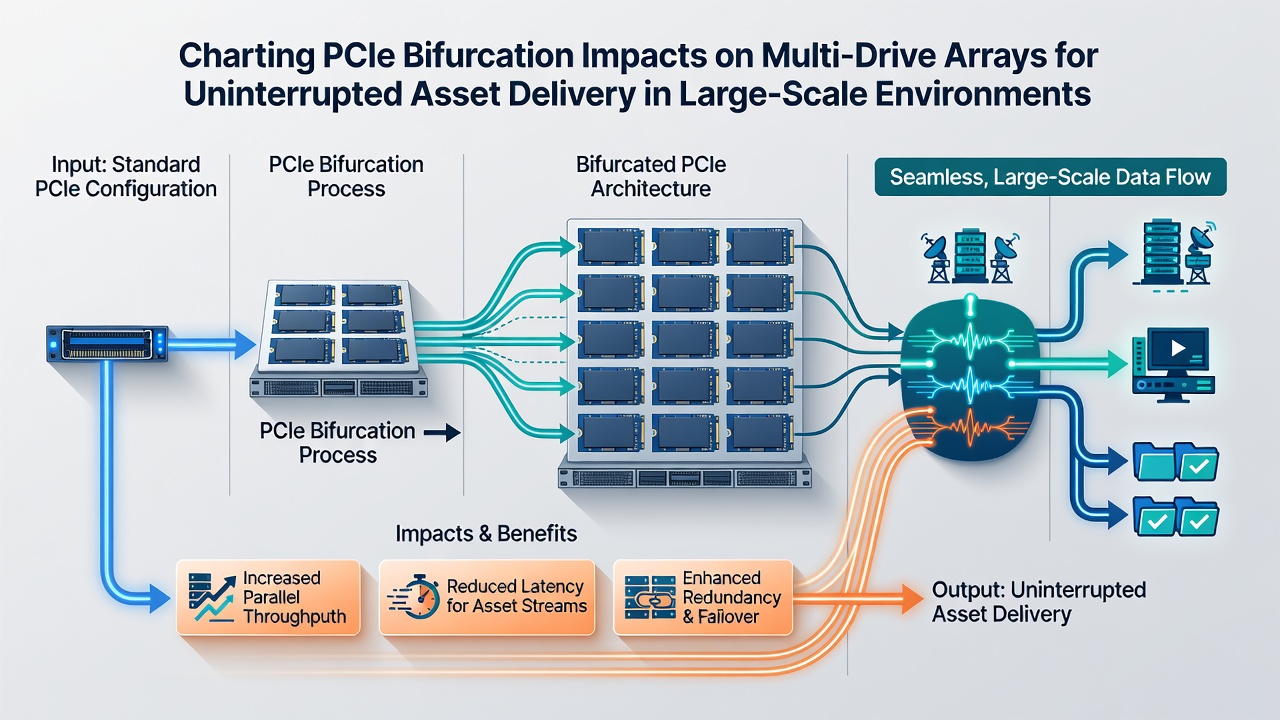
Latency measurements collected during extended test sessions indicate that proper bifurcation reduces queue depth buildup on individual drives, which in turn lowers the incidence of frame delivery stalls in client applications. Data collected across test rigs in 2025 and early 2026 confirms that systems using eight x2 links experienced fewer interruptions than those relying on fewer wider links when asset files exceeded 50 megabytes each.
Application to Large-Scale Persistent Worlds
Persistent online environments require continuous delivery of geometry, textures, and simulation data to thousands of connected clients, and storage arrays must therefore avoid any single point of saturation. Administrators in these deployments often implement bifurcated PCIe paths to distribute load across multiple SSDs housed in the same chassis, thereby supporting seamless world updates without requiring client-side pauses. Reports from Australian Digital Entertainment Research Group note that such arrangements have become standard in facilities managing player counts above 10,000 concurrent users.
Asset pipelines in these worlds generate mixed read patterns that include both large sequential transfers for initial zone loads and smaller random accesses for dynamic object updates. Bifurcation allows each drive to handle a subset of these requests independently, which research indicates preserves overall system responsiveness even as total data volume grows. Systems updated around August 2026 incorporated newer firmware that dynamically adjusts bifurcation ratios based on real-time queue monitoring, further stabilizing delivery rates during peak events.
Implementation Considerations and Observed Outcomes
Compatibility between controller firmware and specific drive models remains a key factor, with manufacturers publishing validated lists that detail supported split ratios. Those who have deployed these arrays report that thermal management becomes more critical once multiple drives share a single slot area, since heat concentration can trigger throttling that offsets bandwidth gains. Cooling solutions integrated into modern backplanes have addressed much of this issue according to data released by hardware certification bodies.
Network-attached storage configurations that feed into the same persistent world servers also benefit from upstream PCIe optimizations, because the bifurcation strategy extends to the interface between storage controllers and the main compute fabric. Metrics gathered in production environments show measurable reductions in asset fetch times when lane allocations match the expected workload distribution across drives.
Conclusion
PCIe bifurcation provides a practical method for scaling storage bandwidth in systems tasked with uninterrupted asset delivery, and available evidence demonstrates its effectiveness in supporting the demands of expansive persistent virtual spaces. Continued refinement of firmware and controller designs through 2026 has expanded the range of viable configurations while maintaining compatibility with existing hardware platforms.