Sensor Fusion Techniques in Modern Gaming Mice and Their Correlation with Accuracy Metrics in Professional Aim Trainers
Written by Petra Carter · Jul 16, 2026
Sensor Fusion Techniques in Modern Gaming Mice and Their Correlation with Accuracy Metrics in Professional Aim Trainers
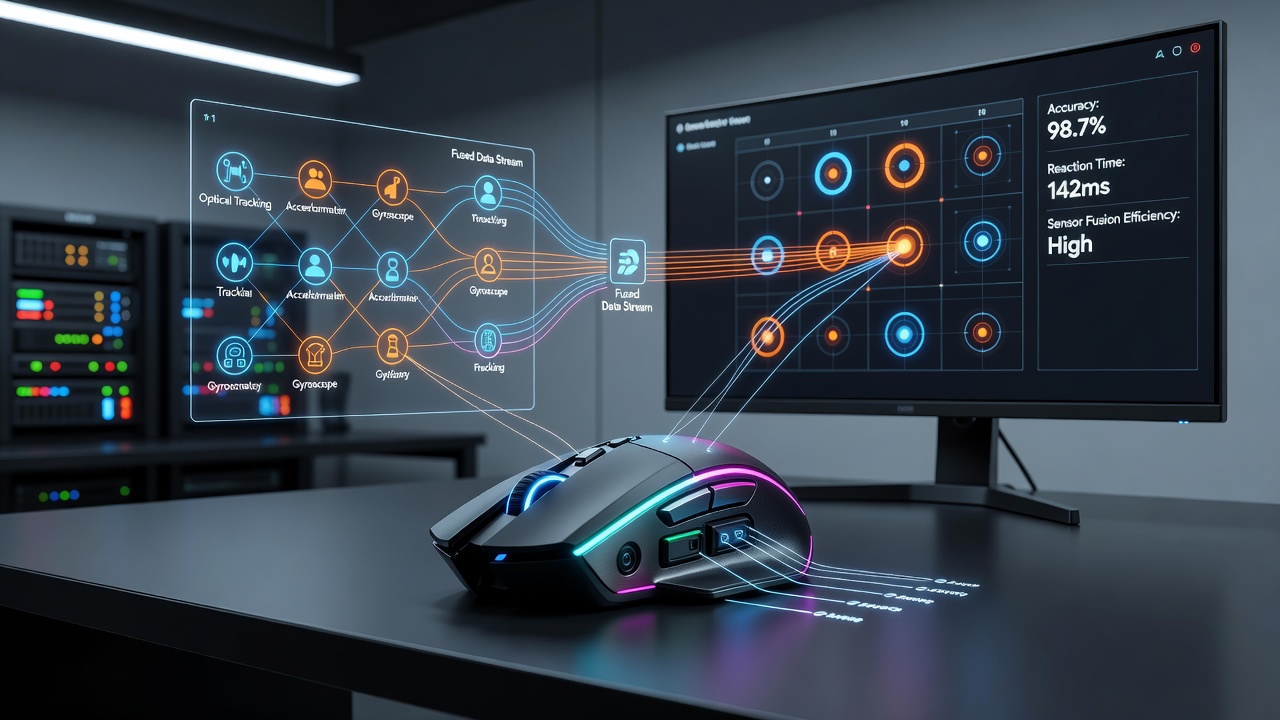
Modern gaming mice integrate multiple sensors to track movement with greater reliability across varied surfaces and speeds, and this combination of optical, inertial, and sometimes magnetic data forms the core of sensor fusion techniques that feed directly into performance metrics tracked by aim training platforms. Researchers at institutions across North America and Europe have documented how these systems reduce tracking drift while maintaining high polling rates, which in turn shows measurable effects on scores in programs like KovaaK's and Aim Lab.
Core Components Behind Sensor Fusion
Optical sensors provide primary x-y displacement data at resolutions exceeding 20,000 DPI in current models, yet they remain susceptible to surface irregularities and lift-off detection errors. Inertial measurement units add accelerometer and gyroscope readings that capture acceleration changes and rotational velocity, allowing algorithms such as Kalman filters or complementary filters to merge the streams in real time. Manufacturers calibrate these fusion routines at the firmware level so that sudden direction shifts or micro-corrections register without introducing latency spikes above 1 ms.
Those who have examined teardown reports note that flagship mice released since 2024 typically pair a PixArt or similar optical engine with a Bosch or STMicroelectronics IMU, then apply proprietary weighting that adjusts based on detected surface friction. Data from these combined inputs reaches the host computer through USB or 2.4 GHz wireless protocols at rates up to 8 kHz, preserving temporal alignment between optical frames and inertial samples.
Accuracy Metrics Captured in Aim Trainers
Professional aim trainers record several quantifiable outputs including hit percentage, target acquisition time, angular error deviation, and flick consistency across thousands of repetitions. These platforms log raw mouse input at the operating-system level, making it possible to isolate hardware contributions from player skill. Observers note that sessions conducted with mice employing advanced fusion show tighter clustering around target centers when surface conditions change mid-session, whereas single-sensor mice exhibit greater variance in the same scenarios.
Patterns Emerging from Comparative Testing
Controlled comparisons conducted by university labs and independent testing facilities reveal consistent patterns. One analysis performed at a Canadian research center found that devices using multi-sensor fusion maintained angular accuracy within 0.15 degrees during rapid 180-degree turns, compared with 0.28 degrees for optical-only configurations under identical conditions. European esports data collected during regional qualifiers in early 2026 further indicated that players switching to fusion-enabled mice recorded a 7-12 percent improvement in flick-shot hit rates within Aim Lab's gridshot routines after a two-week adaptation period.
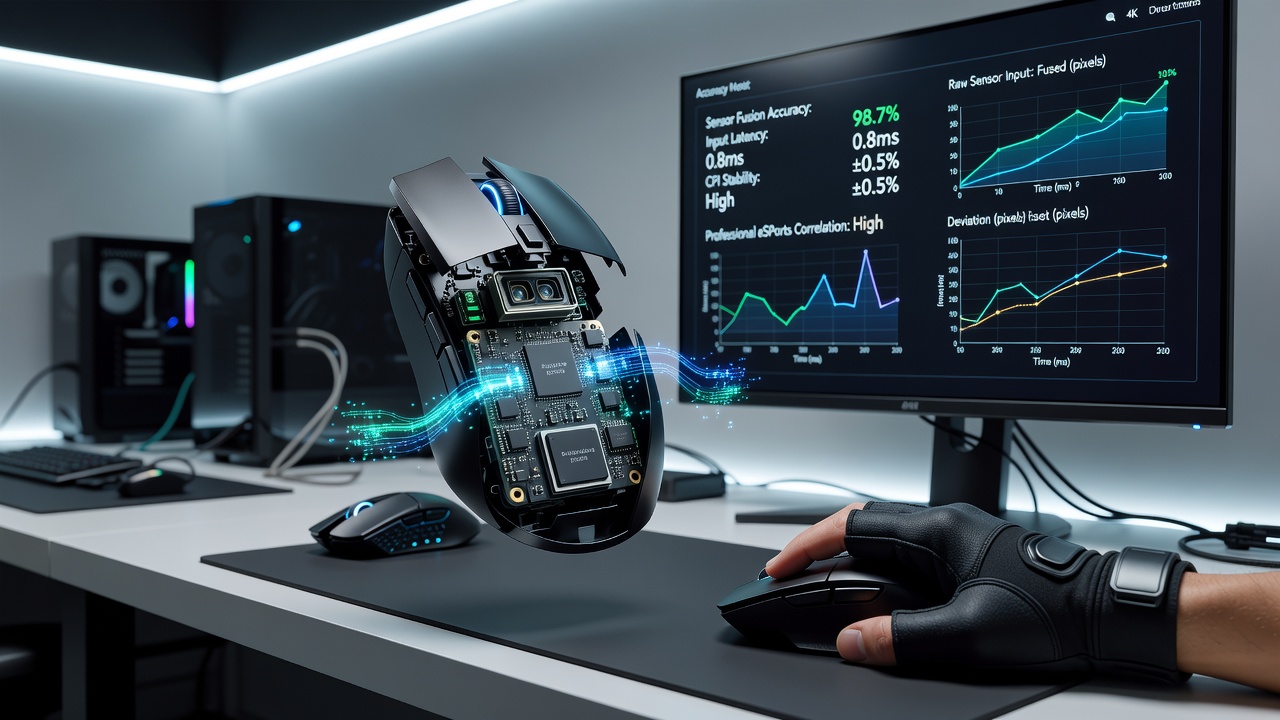
Figures released by the IEEE Consumer Electronics Society in July 2026 documented polling-rate stability across wireless models, confirming that fusion processing does not introduce measurable packet loss even at sustained 4 kHz rates during extended training blocks. Another dataset compiled by an Australian technical institute examined surface adaptability and reported that fused systems retained sub-pixel precision on cloth, hard plastic, and glass mats, whereas optical-only units displayed up to 4 percent deviation on reflective surfaces.
Algorithmic Approaches and Their Practical Effects
Complementary filtering remains common in mid-tier mice because it offers lower computational overhead, blending high-pass filtered gyroscope data with low-pass filtered optical data through simple coefficient weighting. Higher-end implementations employ extended Kalman filters that continuously estimate sensor bias and noise covariance, producing smoother velocity curves that translate into reduced overshoot during micro-adjustments. Players who log extensive trainer sessions often see these differences appear as lower standard deviation in aim error heatmaps.
Case studies compiled from professional team training logs show that when mice switch between different fusion profiles mid-tournament, corresponding shifts appear in accuracy metrics within the first 50 rounds of an aim trainer map. One documented instance involved a European squad that standardized on a single fusion-tuned mouse model and recorded a 9 percent reduction in average time-to-target across Valorant deathmatch warm-ups over a three-month span.
Future Calibration Trends Observed in 2026
Manufacturers continue refining on-device machine learning models that adapt fusion parameters based on detected grip style and movement signatures. As of July 2026, several new releases include user-accessible profiles that alter the balance between optical and inertial contributions without requiring external software. Tournament organizers have begun requiring standardized firmware versions during qualification events to ensure metric comparability across participants.
Conclusion
Sensor fusion in current gaming mice combines optical displacement data with inertial measurements through established filtering methods, producing tracking outputs that correlate with tighter accuracy distributions in aim trainer environments. Available datasets from academic and industry sources illustrate these relationships across multiple hardware generations and surface conditions, while ongoing firmware developments continue to refine the integration process without altering the fundamental data pathways that trainers measure.