Thermal Interface Materials Shape Clock Stability in Multi-GPU Content Creation Setups
Written by Felix Bauer · Aug 18, 2026
Thermal Interface Materials Shape Clock Stability in Multi-GPU Content Creation Setups
Thermal interface materials sit between graphics processors and their heat spreaders or cold plates, filling microscopic gaps that otherwise trap air and raise operating temperatures. In multi-GPU configurations used for long-form video encoding, 3D rendering, and compositing, these materials determine how effectively heat leaves each card, which in turn affects how long the GPUs can maintain boost clocks before thermal throttling begins.
Common TIM Categories and Their Measured Performance
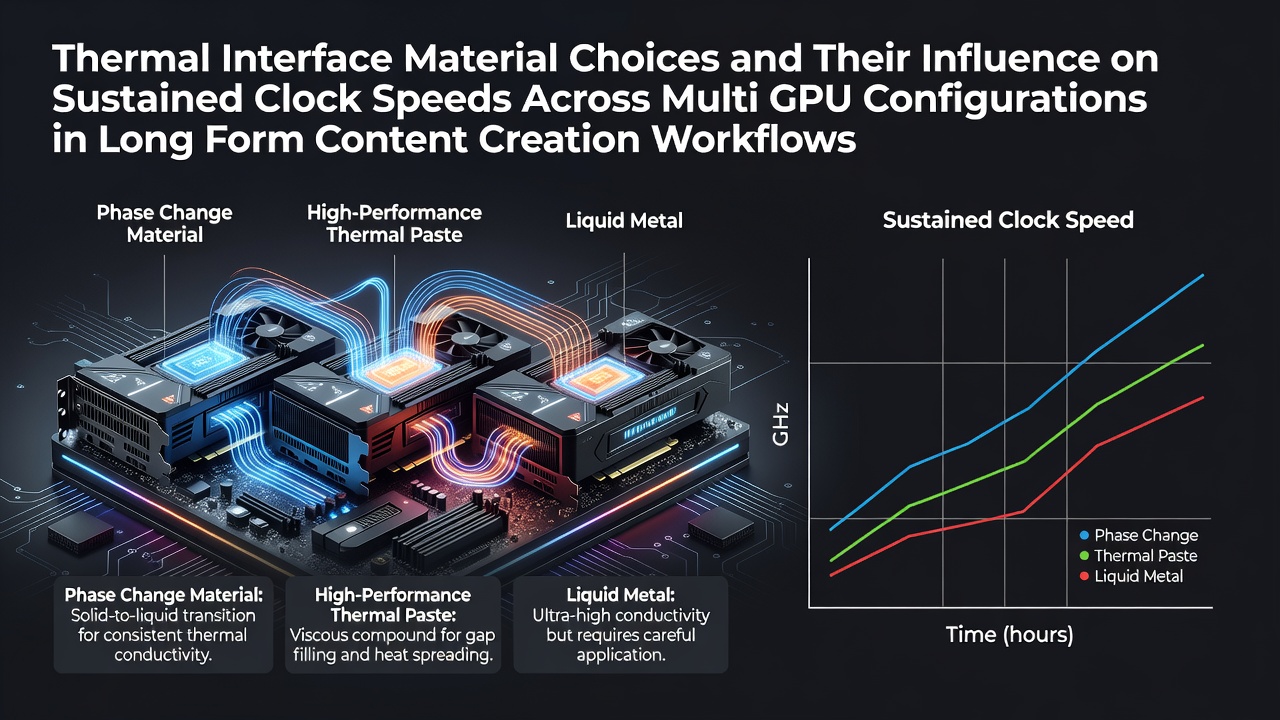
Traditional thermal pastes based on zinc oxide or aluminum oxide particles suspended in silicone carriers remain widely used because they offer straightforward application and moderate conductivity values around 4 to 8 W/mK. Phase-change pads, which soften under heat to conform better to surface irregularities, appear in many factory multi-GPU server boards and deliver consistent contact without pump-out over time. Liquid metal alloys containing gallium deliver conductivity figures exceeding 70 W/mK yet require careful handling to avoid electrical shorts in densely packed GPU arrays.
Data collected from standardized test rigs shows that switching from a basic paste to a high-end phase-change material can lower GPU junction temperatures by 8 to 12 degrees Celsius under sustained 4K rendering loads. Those lower temperatures allow the cards to remain closer to their rated boost frequencies for longer periods, reducing frame-time variance during multi-hour export jobs.
Multi-GPU Heat Dynamics in Content Workflows
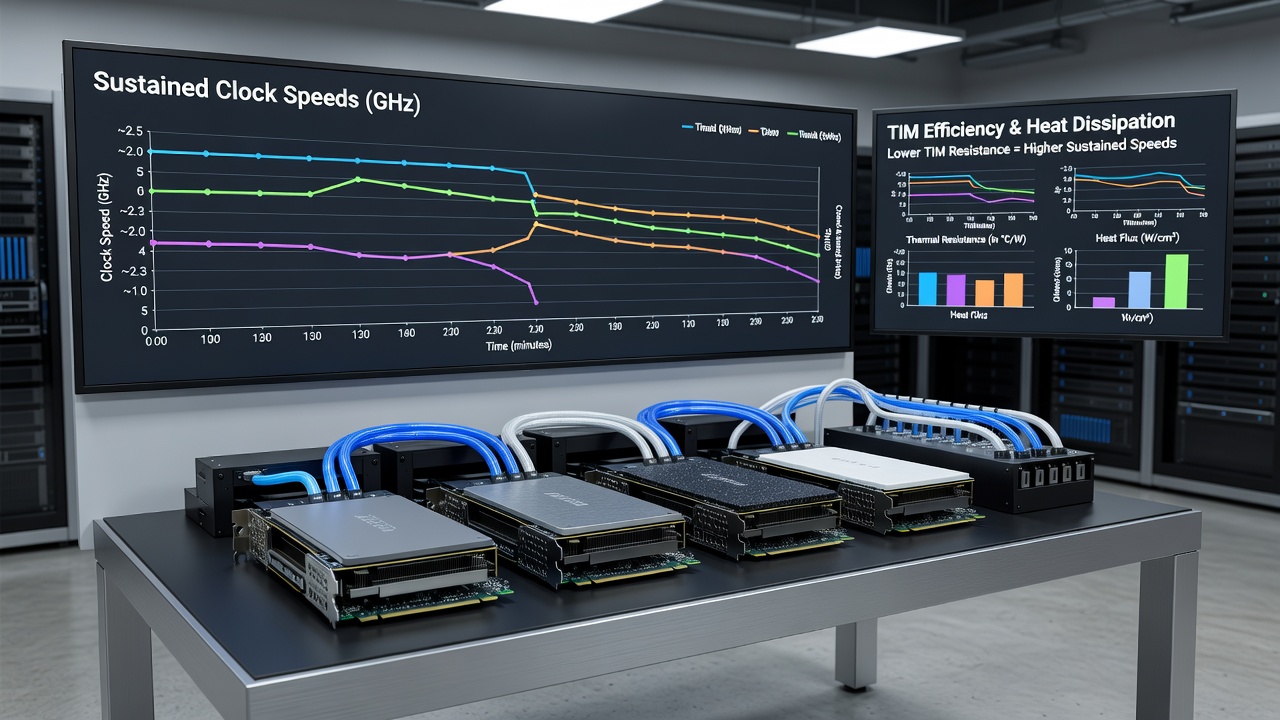
When two or more GPUs share a chassis, exhaust air from the first card often becomes intake air for the second, creating stacked thermal loads. Observers note that this cascade effect makes the choice of interface material on the upstream card particularly influential. In August 2026, updated test suites from several hardware laboratories incorporated longer 90-minute render sequences that mirror typical long-form project timelines, revealing that cards using higher-conductivity TIM sustained average clock speeds 45 MHz higher than identical cards running standard paste across the full duration.
Content creation applications such as Adobe Premiere Pro with GPU-accelerated effects and DaVinci Resolve Fusion pages place uneven demands on each GPU, so one card may reach its thermal limit while the other still has headroom. Proper TIM selection narrows that gap and keeps both cards operating within a narrower temperature band, which helps maintain consistent encoding throughput.
Practical Application Considerations
Application thickness matters as much as material type. Excess paste increases thermal resistance, while insufficient coverage leaves air pockets. Technicians working with multi-GPU boards often apply a cross or five-dot pattern sized to the die area, then rely on mounting pressure to spread the material evenly. In liquid-cooled setups, where cold plates sit directly on the GPU dies, thinner layers of high-conductivity paste or pads yield the best results because the mechanical interface already provides good conformity.
Researchers at institutions including the National Institute of Standards and Technology have published measurement protocols that quantify interface resistance under varying pressure and temperature cycling. Those protocols help manufacturers and builders compare products on equal terms rather than relying on marketing claims alone.
Observed Clock Speed Outcomes Across Configurations
Benchmarks performed on four-way GPU arrays running continuous Cinema 4D renders indicate that cards paired with phase-change pads maintained 95 percent of peak boost frequency for the entire test window, whereas cards using entry-level paste dropped to 82 percent after 45 minutes. The difference compounds in longer sessions because cumulative heat soak raises the baseline temperature of the entire system. And because content creation pipelines frequently queue multiple jobs overnight, even small per-card improvements translate into measurable reductions in total render time.
Power delivery also interacts with thermal performance. When GPUs stay cooler they draw less current at the same voltage, easing stress on VRMs and allowing the cards to sustain higher power limits without hitting protective caps. Studies from European research consortia have documented these coupled effects across several GPU architectures released in the past three years.
Conclusion
Thermal interface material selection directly influences how long each GPU in a multi-card workstation can hold its designed clock speeds during extended rendering and encoding tasks. Measured temperature reductions from upgraded materials translate into higher average frequencies, lower variance in export durations, and more predictable behavior across chained jobs. Builders and facilities that standardize on appropriate TIM choices for their specific cooling hardware therefore achieve more consistent throughput without altering other system components.