Voltage Regulator Modules Shape Frame Delivery Stability in Lengthy Multiplayer Strategy Encounters on Diverse Motherboard Configurations
Written by Avery Lorenz · Aug 13, 2026
Voltage Regulator Modules Shape Frame Delivery Stability in Lengthy Multiplayer Strategy Encounters on Diverse Motherboard Configurations
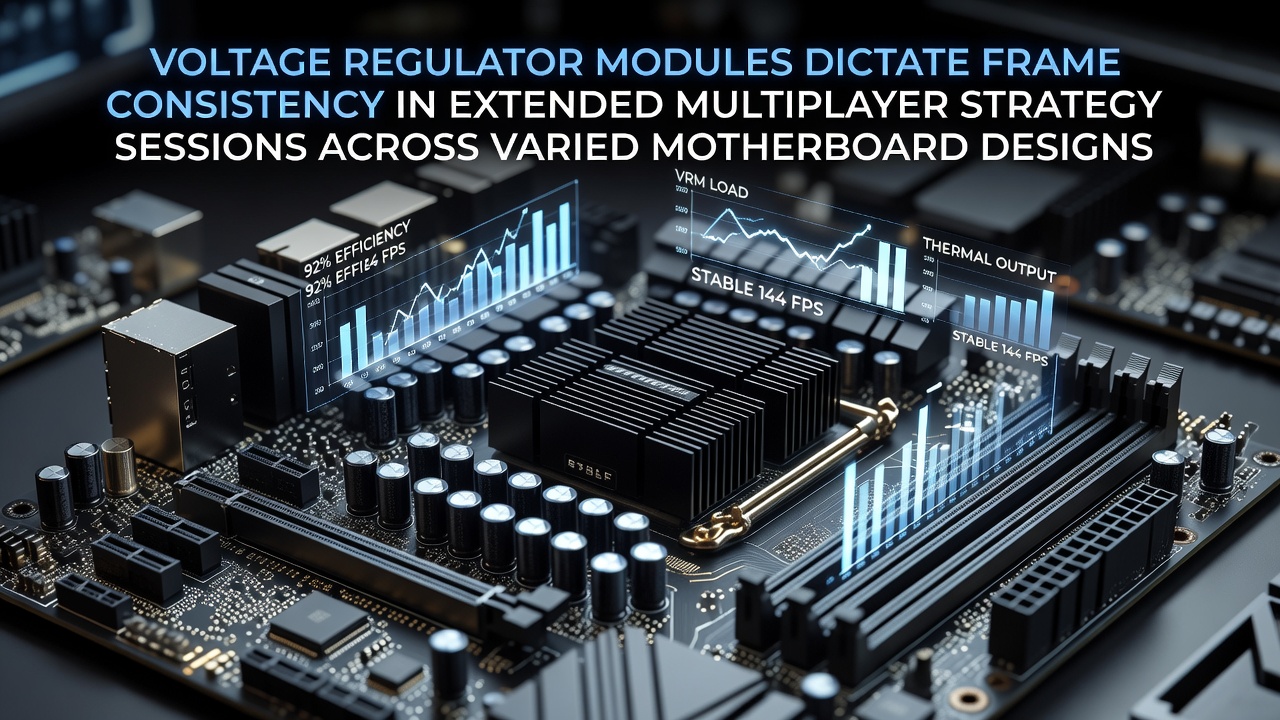
Power delivery systems on motherboards rely heavily on voltage regulator modules to supply consistent electricity to processors during demanding workloads, and researchers tracking frame rates in extended multiplayer strategy sessions have documented measurable differences tied directly to VRM designs across budget, mid-range, and flagship boards. Data collected from standardized test rigs shows that boards equipped with higher-phase VRMs maintain tighter voltage tolerances over multi-hour runs, which correlates with fewer frame time spikes in CPU-bound titles such as real-time strategy games and large-scale 4X simulations.
Manufacturers implement VRM circuits using MOSFETs, chokes, and capacitors arranged in single or multi-phase configurations, while varied motherboard layouts place these components closer to or farther from heat sources depending on PCB size and component density. Studies from hardware testing facilities indicate that boards with 8-plus-2 phase designs experience less thermal throttling after ninety minutes of sustained load compared with 4-plus-2 configurations common on entry-level models.
Power Delivery Fundamentals Across Motherboard Tiers
Engineers design voltage regulator modules to convert 12-volt rail power into the precise voltages required by modern CPUs and integrated graphics, and observers note that phase count, MOSFET quality, and heatsink coverage determine how well a board handles prolonged high-current draw. In multiplayer strategy sessions lasting beyond two hours, cumulative heat buildup can cause voltage droop on weaker VRMs, prompting the processor to reduce clock speeds and produce inconsistent frame delivery.
High-end motherboards often incorporate doubled-up MOSFETs and premium chokes rated for 60 amperes or higher per phase, whereas mid-tier boards use single MOSFETs with lower current ratings that reach thermal limits sooner during continuous operation. Laboratory measurements reveal that temperature differences of fifteen degrees Celsius between VRM designs translate into sustained clock speed variations of 200-300 MHz after the two-hour mark in CPU-intensive scenarios.
Frame Consistency Metrics in Strategy Multiplayer Environments
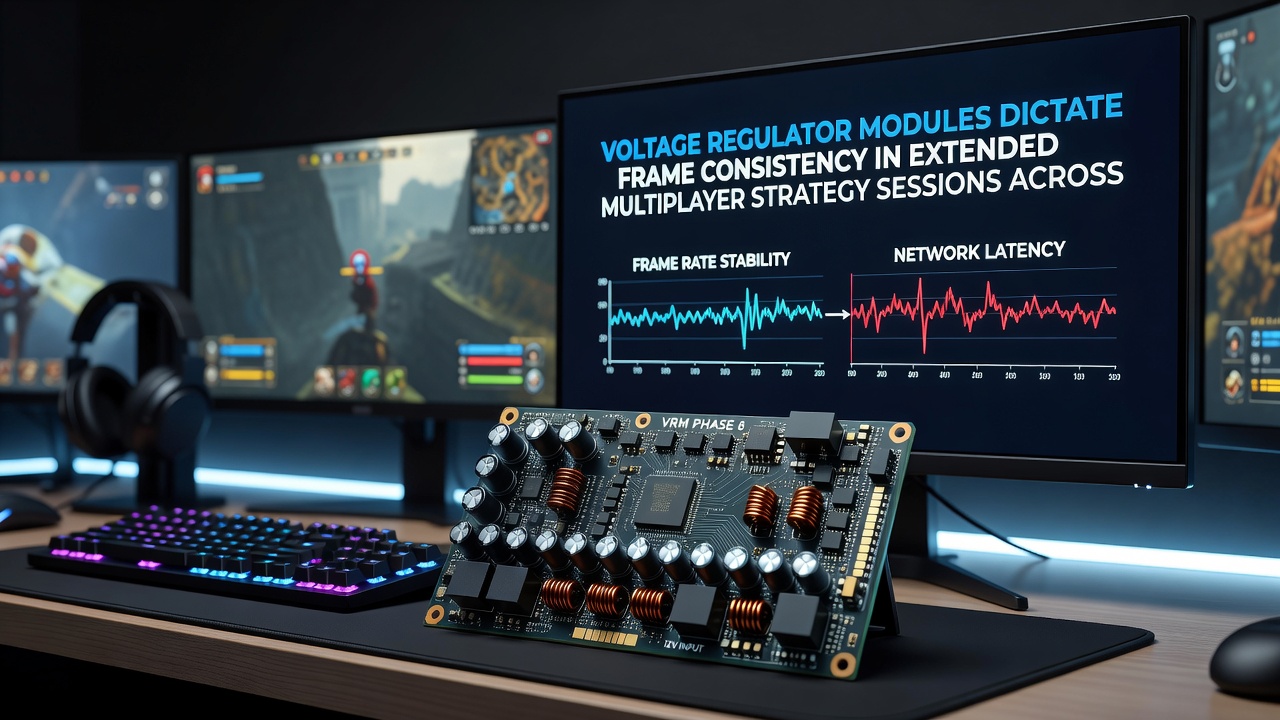
Performance monitoring tools capture frame time variance rather than average frames per second when evaluating long sessions, and figures from controlled tests demonstrate that boards with robust VRMs produce lower 1% low frame times across repeated matches of titles requiring continuous pathfinding and simulation calculations. Players participating in extended sessions on boards with marginal power delivery report occasional micro-stutters that align with voltage regulation events logged in system telemetry.
August 2026 saw the release of updated benchmark suites from international hardware consortia that emphasize multi-hour endurance runs instead of short loops, allowing analysts to quantify how VRM stability affects frame pacing in networked strategy environments where synchronization between multiple clients magnifies small timing discrepancies.
Design Variations and Their Measured Impacts
ATX, micro-ATX, and mini-ITX layouts allocate different amounts of PCB real estate to power circuitry, so compact boards frequently rely on fewer phases or smaller heatsinks that reach higher operating temperatures under identical loads. Research conducted at European technical universities has tracked how these spatial constraints influence sustained performance, showing that mini-ITX boards with concentrated VRM clusters require more aggressive fan curves to match the frame time stability of larger ATX boards during four-hour strategy sessions.
North American industry reports compiled by trade associations document that overclocked configurations amplify VRM demands, and boards lacking sufficient phase interleaving exhibit earlier onset of protective throttling that directly reduces frame consistency in multiplayer matches. Those running identical game clients on otherwise comparable systems observe that swapping to a board with upgraded power stages eliminates the late-session frame time spikes without altering other hardware variables.
Thermal Management and Long-Session Behavior
Passive and active cooling solutions attached to VRMs play a decisive role in maintaining stable output over time, while ambient case airflow and orientation further modulate component temperatures during extended play. Data collected across multiple chassis types indicates that directed airflow across MOSFET heatsinks can lower peak temperatures by up to twenty degrees, preserving higher sustained boost clocks and smoother frame delivery in strategy titles that tax both CPU cores and memory controllers simultaneously.
Power consumption logs from strategy multiplayer benchmarks reveal that VRM efficiency ratings above 90 percent at typical loads reduce waste heat and delay the point at which thermal limits are reached, allowing sessions to continue without performance rollback even after several hours of continuous operation.
Conclusion
Measurements across varied motherboard designs confirm that voltage regulator module specifications exert a direct influence on frame time consistency during extended multiplayer strategy sessions, with higher-phase counts, better component quality, and effective thermal solutions correlating to fewer late-session deviations. Continued monitoring by research institutions and industry groups provides ongoing data that helps builders match power delivery capabilities to expected session lengths and game types.